Interview: Prairie Paws Makes Case for Running Salina’s Animal Shelter, Citing Scale, Grants, and Faster Changes

As discussion around the future of animal shelter operations continues locally, Prairie Paws Animal Shelter leadership says its nonprofit, regional model offers a different structure than a municipally operated shelter — one they say can expand hours, programs, and capacity through scale and specialization.
Brandon Sokol, animal shelter director for Prairie Paws in Manhattan, said the organization’s core distinction is focus.
“We are an animal welfare organization from top to bottom. That’s what we specialize in,” Sokol said. “So it’s not just a department within the city structure where… outside of that department you don’t have anybody that has that animal welfare experience and that institutional knowledge.”
Prairie Paws currently operates municipal shelter services in Manhattan, Emporia, and Ottawa, with another contract in development, according to Sokol.
Regional scale and grants cited as structural advantages
Sokol said Prairie Paws’ multi-community network changes both funding opportunities and per-animal costs compared to a single-city shelter.
“Having this network of animal shelters helps us scale up to where the cost per animal to take care of goes down as we scale up,” he said. “We’re also now opened up to some bigger opportunities for grants… because now we as an organization are seeing 6,000 animals a year, compared to individually less than 2,000.”
He said nonprofit status also allows faster program changes than government structures.
“The speed in changing policies or implementing programs as a nonprofit, compared to the slow wheels of government, has been night and day.”
He cited trap-neuter-return programs and volunteer access as examples of initiatives Prairie Paws expanded after moving out of direct municipal operation.
Hours and public access
Prairie Paws facilities are open daily from 9 a.m. to 6 p.m., seven days a week, Sokol said, describing public access as central to adoption outcomes.
“Letting the public and adopters get access to those animals… is a big part of that,” he said. “We’ve really been able to expand operation hours as Prairie Paws compared to when we were with the city.”
For after-hours situations, he said Prairie Paws facilities allow access through law enforcement partners under agreements, rather than public drop-offs.
Transparency and accountability under contract model
Sokol said Prairie Paws shelters remain subject to public records laws when operating under municipal contracts.
“We are still government contracted, so open records requests do apply to us.”
He said Prairie Paws also publishes monthly and annual statistics reports online detailing intake, adoptions, euthanasia, and transfers.
“We say exactly how many animals we’re housing, adopting, euthanizing, transferring… we give all that information out.”
Prairie Paws reports live-release rates near 95%, according to Sokol.
Intake model and capacity management
Sokol described Prairie Paws’ shelter structure as a hybrid of open admission (for law enforcement and stray intake) and managed admission (for owner surrenders), intended to preserve emergency capacity.
“We have to have the availability to take in those animals from law enforcement partners… that is our primary role and responsibility.”
That model prevents surrendered animals from displacing stray or court-hold animals, he said.
Court-hold dogs and breed pressures
Asked about capacity pressures similar to those seen in Salina, Sokol pointed to long-term court-hold dogs — particularly pit bull-type dogs — as a major factor in shelter crowding statewide.
“We get these animals that have long court cases… that could span years,” he said. “It can be very hard to transfer pit bulls, because there are just so many of those types of dogs in shelters.”
He said prolonged holding creates difficult quality-of-life decisions.
“You kind of have to decide — are we a sanctuary or are we an animal shelter?” he said. “It would not be manageable to sanctuary those dogs here for a number of years.”
Volunteer structure and public engagement
Prairie Paws trains volunteers for specific roles rather than broad certification requirements, Sokol said, describing tailored orientations for dog, cat, or medical support volunteers.
He also emphasized outreach partnerships, including recurring media features of adoptable animals.
“You have to take those opportunities… you never know when someone’s going to see that animal and decide maybe I will go meet it.”
Local discussion context
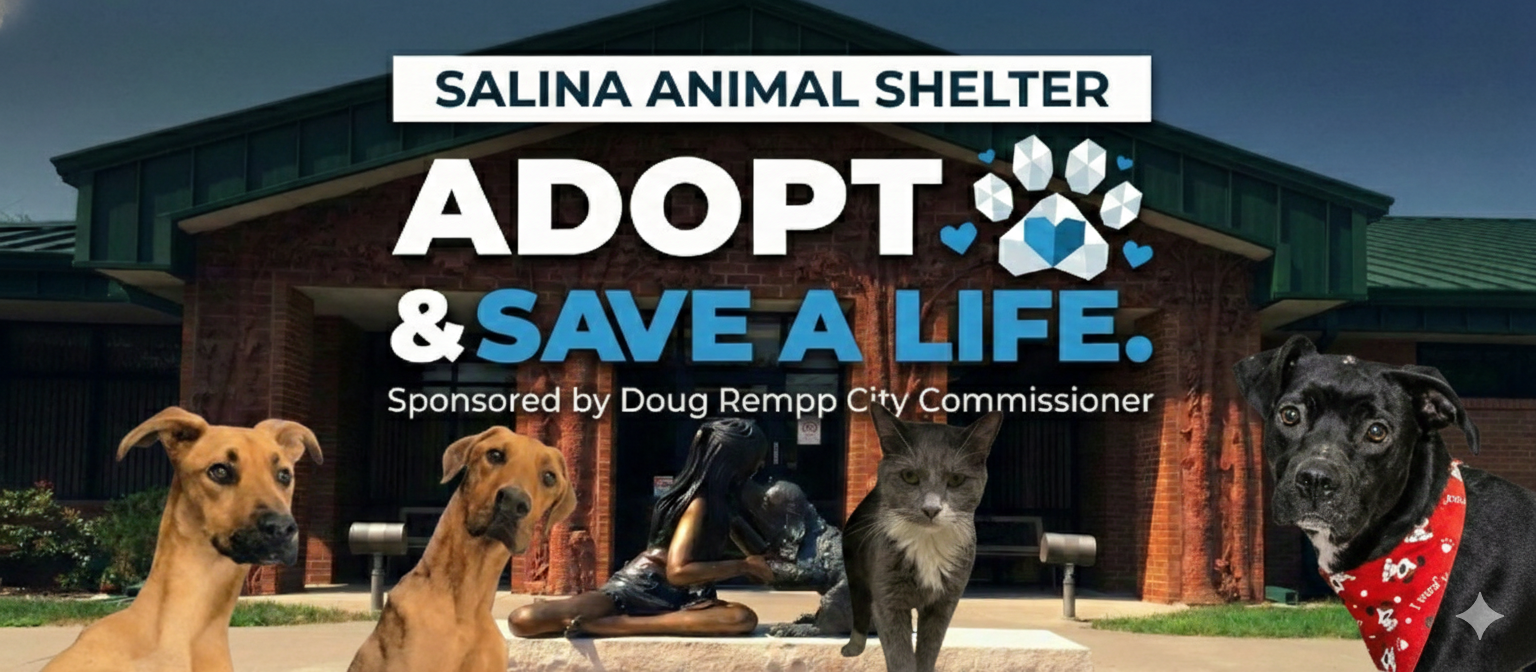
Interest in alternative shelter structures has surfaced in Salina during recent advisory board and public discussions about the city’s animal shelter operations.
Prairie Paws leadership said the organization would be open to discussions if Salina explored a contract model.
“We do expect to continue expanding,” Sokol said.
Coming up in Part 2: We’ll break down what would actually change if Salina contracted animal shelter operations to an outside nonprofit like Prairie Paws, including hours, intake policies, transparency requirements, costs, and the key questions city leaders would need to answer before any shift in operations.
Receive Local Information Like This In Your Inbox
Stay informed with stories and updates from your community