
Inside Salina’s River Project: What Failed, What Passed, and Where the Money Is Now
The Smoky Hill River Renewal project did not move from idea to construction in one straight line. It has been built over years through a mix of public planning, one failed tax vote, a later approved tax, federal grant money, U.S. Army Corps of Engineers work, city reserves, and now private fundraising for pieces the city still does not have fully funded. The current version of the project is not the same political package voters rejected in 2010, but it is also not unrelated to it. It is the same river vision, reworked into phases and funding buckets that have been assembled over time.
The story goes back much farther than the last few years of bridge drawings and fundraising announcements. Friends of the River’s timeline traces organized efforts to the late 1980s and early 1990s, after the old river channel had already been cut off by the levee and bypass channel work that followed the 1951 flood. The City’s current project page and the Corps’ study page both say the original 6.8-mile channel through town lost sustained base flow after the federal flood-control system was built, leaving the old channel to collect sediment and urban runoff instead of functioning like a river. By 2006, the city’s shared-vision planning process had river-related goals in it, and by 2008 and 2009, Friends of the River had been authorized to do public outreach and said it collected input from roughly 3,500 participants.
The first major modern turning point came in 2010. The City adopted the Smoky Hill River Renewal Master Plan after public meetings, advisory committees, and technical review. The City says that plan identified improvements, locations, costs, possible funding sources, phasing, and maintenance needs, and that the City Commission accepted it in August 2010. But the funding question immediately became the fault line. Friends of the River’s own history says a dedicated 0.25% sales tax for a $27 million first-phase river package was defeated later that year by 65.2% to 34.8%, or 9,217 votes to 4,929. According to that same timeline, the rejected package was supposed to cover water flow work, culvert repairs, bridge replacements, sediment removal, multi-use trails, and a hardscape downtown river walk, and would have pushed Salina’s sales tax from 8.2% to 8.45% during a recession period that also included a state sales tax increase.
That 2010 defeat matters because it was not a vote against having any river conversation at all. It was a vote against that specific river-only tax package at that moment. The project did not disappear after that loss. Instead, the City kept the master plan alive and Friends of the River kept pushing. By 2016, the political approach had changed. Instead of returning with another standalone quarter-cent river question, the City went to voters with a broader 0.75% citywide retailers sales tax to replace the older 0.40% special sales tax. The City’s budget documents say voters approved that 0.75% tax in May 2016 for capital improvements and economic development, and the river project page says a portion of those funds would go toward Smoky Hill River Renewal after Kenwood Cove’s $1.3 million annual debt service is retired, producing about $20.8 million over 16 years. Friends of the River describes that same tax stream more aggressively, saying $1.35 million a year for 20 years would go to the river, or about $27 million. Those are not identical public descriptions, but they point to the same basic reality: the project’s main local funding source became part of a broader city sales-tax package that voters did approve in 2016.
Public opinion after 2016 did not suddenly become uniform. In 2017, the City put the river project back through a refined planning process and surveyed the public again. The survey drew 663 responses. The top-ranked priority was improving water quality and quantity through the channel. The most-preferred recreation ideas were multi-use trails, a boardwalk area at river level, and non-motorized boating like kayaks and canoes. But the City’s own summary also says negative comments centered on project costs, ongoing maintenance, prior ballot initiatives, safety and security, and litter and vandalism. In other words, even after the 2016 tax passed, the local conversation still included the same old arguments: people liked the idea of a better river, but many remained suspicious about cost, upkeep, and how much taxpayers would end up carrying.
That is where the project really started to change shape. City documents from 2017 and 2021 show the river renewal stopped functioning as one all-at-once package and started functioning as a stack of linked phases. The City’s 2017 handout said HDR, an engineering, architecture, and planning firm, had been hired to refine the master plan because of “existing or changed conditions and budget constraints.” The 2021 public meeting presentation described a project structure that included $13.5 million in funding tied to the 2016 voter-approved sales tax for the first phase and $10 million in federal ecosystem-restoration money under the old Corps framework. The City’s current project page also breaks the work into separate tracks: local design and trail work, the Corps restoration plan, and now the RAISE-funded bridges and public-space package.
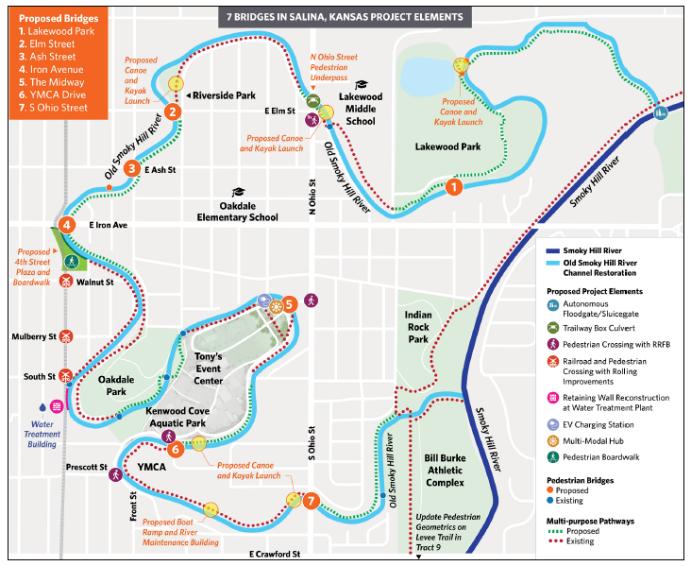
That phased structure is even clearer today. The local-sales-tax side became one funding bucket. The U.S. Army Corps of Engineers became another. The federal RAISE transportation grant became another. Private philanthropy became another. The City’s project page says the Corps initially represented a possible $10 million in ecosystem-restoration funding under the Section 1135 Continuing Authorities Program, a U.S. Army Corps of Engineers authority used to modify existing Corps projects to restore the environment, while the Corps’ own project page says the study was later converted from a CAP Section 1135 project to a General Investigations Study in July 2024. Friends of the River’s history says that by 2024 the Corps had entered a cost-sharing contract with the City for a possible $13.7 million for the waterway portion. Separately, Friends says the City received a $22.1 million RAISE grant for seven bridges, trails, lighting, underpasses, boat ramps, a maintenance facility, part of the boardwalk, and related work. The City’s current update page says the grant-funded bridge and trail work is now part of the main design package expected to be completed in 2026.
Private fundraising is now filling yet another part of the picture. In April 2026, Jane Anderson told the Salina City Commission that Friends of the River had brought in “over $8 million in confirmed pledges and gifts.” That same City Commission cycle tied $1.5 million from Kubota/Great Plains to Kubota Plaza, $2 million from the Applequist family to the Lakewood natural area, and $1.6 million to the Earl Bane Foundation Founders Park Trail. Those gifts are not replacing the city sales tax or the federal grant money. They are helping fund pieces the city has chosen to move as part of the broader river buildout, especially the named public spaces and enhancements that sit on top of the basic infrastructure and water-restoration work. Earlier donor support also helped fund the first half-mile YMCA trail, with the Salina Area Chamber of Commerce publicly naming donors including Sunflower Foundation, Great Plains/Kubota, Earl Bane Foundation, Salina Regional Health Foundation, and several individuals.
If the question is where the money stands right now, the answer is that the City has clearly started setting aside river-specific local money while also acknowledging that the full package still has a gap. The 2023 City budget included a $4,746,756 transfer into a River Renewal Project Reserve. The City’s 2026 budget says the current 0.75% special-purpose city sales tax now supports streets, park maintenance, debt support, and the Smoky Hill River Renewal Project, and is projected to generate about $11.8 million in sales and use tax revenue in 2026. But the City’s draft 2026-2030 Capital Improvements Program also says the City’s excess commitment for the RAISE grant, 7 Bridges Project, and Corps River Renewal Project is estimated at $12 million, with funding options listed as $5.5 million in general fund balance, $1.5 million from the utilities fund, $1 million in ARPA funds, $2 million from streets, and $2 million in general obligation bonds backed by property tax. That is not a casual number. It is the City itself saying there is still a substantial local share to cover even after the sales tax, grant, and federal partnership money are counted.
The City is also now spending real money on the project’s path to construction, not just talking about it. In May 2025, the City Commission approved an agreement with HDR for real-property acquisition services for Phase I construction, in an amount not to exceed $200,340. The commission minutes on that item make clear the City is already dealing with the land side of the project and that eminent domain was discussed publicly as a possible tool if property could not be acquired after mediation. At the same time, the City’s update page says the overall project was in design in 2025, was about 60% complete, is expected to finish design in 2026, start construction in 2027, and reach completion in 2030.
So did the City and Friends of the River find a way to run the project through the system piecemeal after voters rejected it? In practical terms, yes. The project that exists today is undeniably a phased project, with separate buckets for river restoration, bridges, trails, plazas, park elements, private donor pieces, land acquisition, and future “to be funded” items. But that does not mean the City simply ignored the 2010 rejection and imposed the same plan anyway. The public record shows something more complicated: voters rejected a dedicated river-only quarter-cent tax in 2010, then later approved a broader citywide 0.75% capital-and-economic-development tax in 2016, and the City subsequently layered that local vote with federal grants, Corps participation, reserve transfers, and private philanthropy. That is not a single clean yes or no story. It is a long-running project that survived by changing form, changing funding sources, and moving in pieces after its first funding package failed. Whether that feels like responsive government or a strategic workaround depends on where you stand. But on the documents, the project’s path is clear: it was rejected once as a standalone ask, revived through a different citywide vote, and is now being built out as a multi-source, phased corridor project rather than the one-shot package Salina voters turned down in 2010.