Salina Officials Review Water Quality Concerns, Aging Cast Iron Waterlines and Possible Water Rate Increases
The Salina City Commission is holding a special study session Wednesday to discuss water quality concerns and the condition of the city’s aging water infrastructure, including old cast iron waterlines tied to discoloration complaints in parts of the community.
City officials opened the meeting by saying clean water is a necessity and that Wednesday’s discussion is likely not the only study session that will be held on the issue.
The purpose of the study session, according to city officials, is to update commissioners and the public on what has been done in the past, what maintenance and replacement work is currently scheduled, and what short-term and long-term goals may be needed for the city’s water system.
City Manager Jacob Wood acknowledged that Salina has water quality issues in its system. He said when water quality complaints are received, city crews respond by checking the water, flushing lines, testing, and using other maintenance steps. However, Wood said there are points where mechanical steps are no longer enough and certain waterlines must be placed into the replacement schedule.
Wood said Salina has a large number of old waterlines, including lines that are 50, 75, and even 100 years old. He said replacing those lines is expensive and competes with other required system improvements, including work on water towers, the wastewater treatment plant, and the water treatment plant.
According to Wood, the city has spent more than $100 million on water and wastewater system improvements over the last 10 to 15 years. He also said Salina has spent approximately $27 million to $28 million on water main replacement since about 2010.
Wood said the water system is operated as an enterprise fund, meaning it is funded by user fees rather than general taxes, sales taxes, or outside revenue sources. Because of that, he said decisions about waterline replacement are tied directly to water rates and what the public can support.
Utilities Director Martha Tasker then gave commissioners background on Salina’s water system and the city’s past planning efforts.
Tasker said the city began work on a water distribution system model with PEC out of Wichita in the late 2000s. That model was designed to help the city understand water flow, fire hydrant capacity, water age, storage, pumping, and areas where flow was restricted.
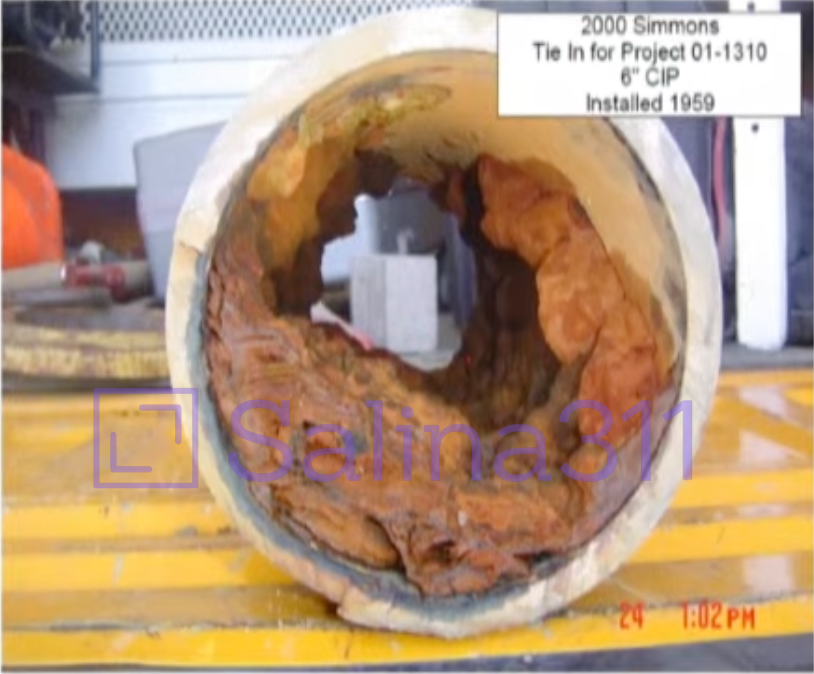
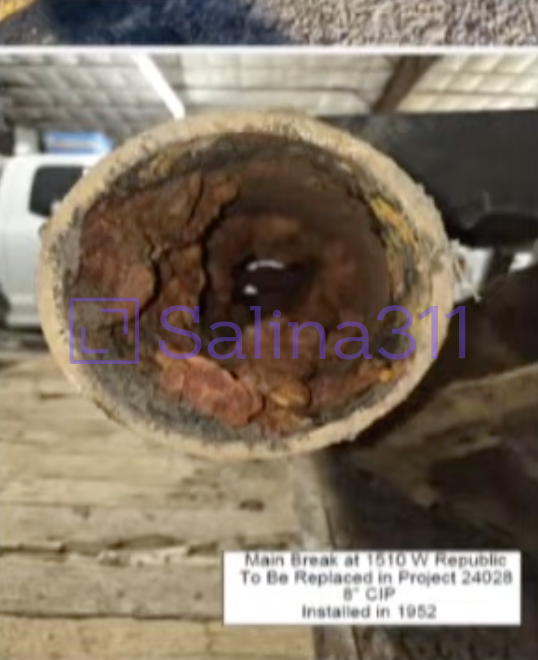
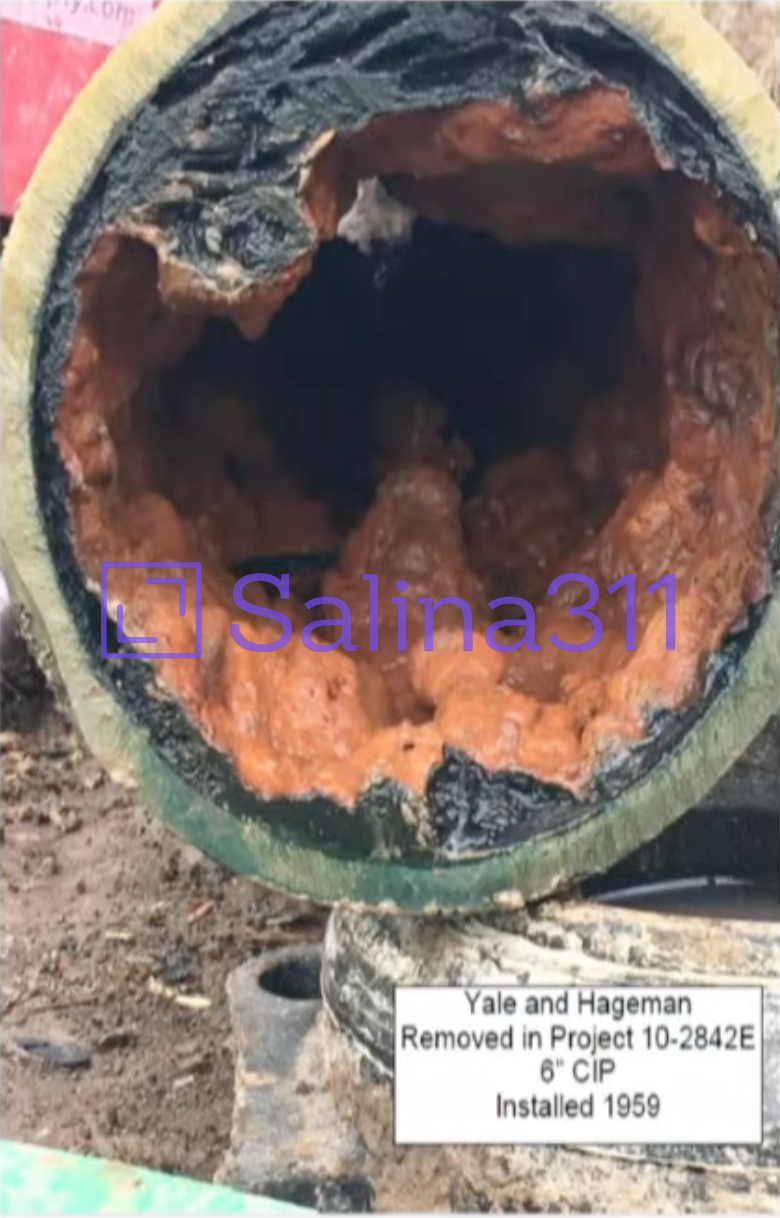
Tasker said those restrictions often appear in areas with cast iron pipe and tuberculation, which is buildup inside the pipe. She said Salina has more than 340 miles of water pipe in its system, and a large share of that is cast iron pipe, including more than 100 miles of six-inch cast iron pipe.
Tasker said the issue with older cast iron pipe is that it was not lined, meaning the water is exposed directly to the metal. Over time, that pipe can rust, and those rust particles can enter the water, contributing to red or discolored water.
Tasker said when she first came to the city, Salina was already dealing with red water issues, but water main replacement was more reactive than proactive. She said the city’s first formal water main replacement plan began around 2010.
According to Tasker, the city’s planning identified six-inch cast iron pipe that was at least 50 years old as a major concern. While some of Salina’s pipes are more than 100 years old, Tasker said the city’s most significant water quality problems have not necessarily come from the oldest lines. Instead, she said the biggest issues have been found in pipes from the 1950s and 1960s, now roughly 50 to 70 years old.
Tasker said those lines have been a focus because they are tied to both water quality complaints and water main breaks.
Tasker also explained the transition in pipe materials over time. She said cast iron was commonly used when Salina was developing. Ductile iron pipe, which includes an interior concrete coating to keep water from directly contacting metal, began appearing in the system around the 1970s. The city later moved toward PVC water mains around the late 1990s or early 2000s.
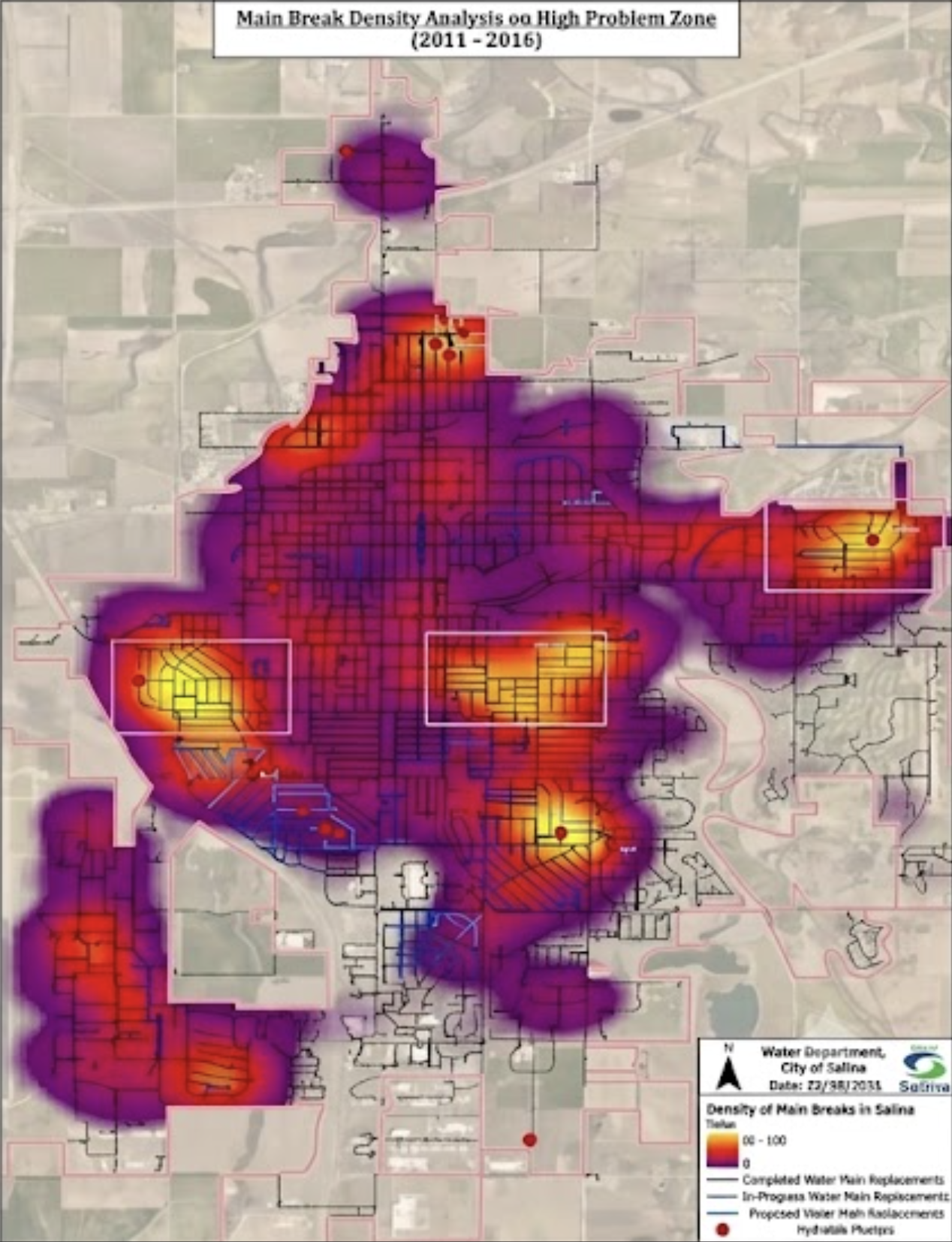
Tasker said city staff use complaint data, water main break records, and heat maps to help determine where replacement work should be prioritized. She said those maps show areas where water quality complaints and water main breaks have appeared over time, including parts of western Salina and areas along North Ninth Street.
Replacement Costs Have Increased
Information presented during the study session also showed the rising cost of water main replacement projects.
A city chart listing water main replacement projects from 2010 through 2026 showed approximately $27.6 million in replacement work across just under 44 miles of water mains. That aligns with Wood’s statement that Salina has spent about $27 million to $28 million on water main replacement since around 2010.
The chart showed early projects costing far less per mile than more recent projects. Project No. 10-2842 Phase I, completed in 2010-2011, replaced two miles of water main at a cost of $776,239, or about $388,120 per mile. That project had eight bidders.
By comparison, the 2025 Water Main Replacement project listed for 2026 is projected at $2,837,180 for 1.93 miles, or about $1.47 million per mile. That project listed two bidders.
The cost per foot also increased sharply. The 2010-2011 project was listed at $73.51 per foot. The 2025 project listed for 2026 was shown at $278.42 per foot.
The chart also showed fewer bidders on several recent projects. Earlier projects listed five to eight bidders in 2010-2012. More recent projects listed one bidder in 2025 and two bidders in 2026. A 2023 emergency repair listed only one bidder and a much higher cost per mile, though emergency work is not directly comparable to regular planned replacement projects.
Recent examples from the chart included:
2024: 2.3 miles replaced at a cost of nearly $2 million, or about $868,211 per mile, with three bidders.2025: 1.75 miles replaced at a cost of about $2.36 million, or about $1.35 million per mile, with one bidder.2026: 1.93 miles listed at about $2.84 million, or about $1.47 million per mile, with two bidders.
The cost data adds another layer to the discussion facing commissioners. While city officials said aging cast iron lines are contributing to water quality complaints in some areas, the price of replacing those lines has increased substantially since the city began its formal replacement planning.