
Rempp and Davis Lead Waterline Questions as Lenkiewicz, Ivey and Hoppock Weigh In
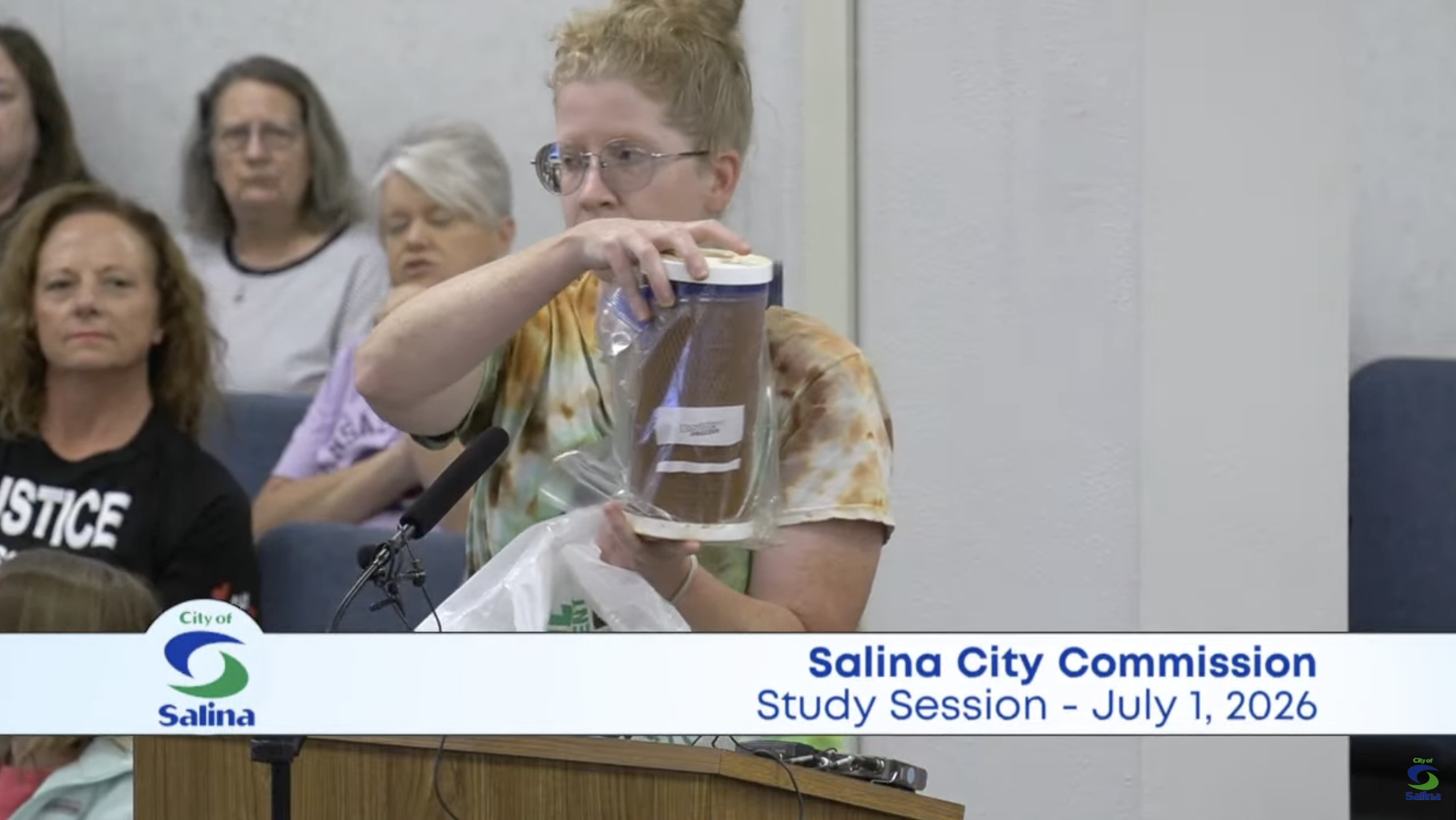
Salina city commissioners questioned city staff during a water quality discussion about the pace of waterline replacement, the condition of aging cast iron mains, whether larger projects could bring better bids, and what short-term relief may be available for residents dealing with discolored water.
The discussion centered on the city’s older cast iron water mains and how quickly Salina can replace problem lines while balancing costs, contractor availability, financing options and disruption to neighborhoods.
Commissioner Doug Rempp
Commissioner Doug Rempp asked Martha Tasker for clarification on the city’s cast iron waterline inventory and how much of the system may be at or beyond its expected service life.
Rempp first confirmed that Richard Sims is part of Tasker’s department. Tasker answered, “Yes, Richard Sims is,” before the discussion turned to the number of miles of cast iron pipe still in the system.
Rempp said he understood the city had more than 100 miles of cast iron pipe. Tasker confirmed the discussion involved approximately 123 miles, while noting that the number can shift as city staff correct mapping and GIS records.
“There may be a little variation in miles because, different over time, we find errors in our GIS piping and mapping,” Tasker said. She said the city corrects records when staff determine whether a line was entered incorrectly as ductile iron or cast iron.
Rempp then asked how much of the pipe is at or beyond its expected service life. Tasker said the last cast iron pipe was likely installed around 1970, making the newest sections roughly 56 years old. However, she said the city does not believe all of it must be replaced at once.
“We don’t think all 133 miles has to be replaced,” Tasker said. She said staff are working through “main breaks and water quality” and using fire hydrant flow data to determine which areas have the most concern.
Rempp asked how many miles the city expects to replace in 2026. Tasker said one current project includes about two miles, while another upcoming project is expected to cover about three and a half to four miles.
Rempp pressed Tasker on how many miles per year the city needs to replace to catch up, repeatedly asking her to answer the question without focusing first on cost.
“Forget about the cost,” Rempp said. “How many miles a year do we need to do?”
Tasker said the city’s original goal was about four miles per year, but she acknowledged that the city has fallen behind because rising costs have reduced how much pipe can be replaced.
“We’d like to do about, our goal in the beginning was about four miles a year,” Tasker said. “I’d like to do a little more than that, because we fell behind with the cost of this. We’re not getting as much done as we want to.”
Rempp also questioned whether the city should rethink other major projects if residents are still dealing with discolored tap water. He specifically referenced river renewal and said the city may need to reconsider “wants versus needs.”
“This year, we’ve talked about river renewal multiple times,” Rempp said. “Quite frankly, I think there’s more money going into that bucket, I’m going to call it, than what is being spent on replacing water lines, and I think to anybody that their tap water is not good in our community, that’s messed up priorities.”
A city official responded that prioritization is part of the annual budget process and said the water system has historically been supported as an enterprise fund through user fees, not property tax or sales tax dollars. The official said commissioners could direct staff to review other options if that is the will of the commission.
Commissioner Greg Lenkiewicz
Commissioner Greg Lenkiewicz focused on whether waterline replacement in one neighborhood area would solve water quality issues on nearby streets.
Lenkiewicz said a resident from Bel Air Drive had contacted him. He noted that Bel Air is near Dover Circle and asked Tasker whether addressing Dover Circle would help nearby Dover Drive, depending on how the waterlines are connected.
“If we address the issue on Dover Circle, are we going to alleviate that problem on Dover Drive?” Lenkiewicz asked. “Or is it kind of depending on how things are connected together?”
Tasker said she was answering from memory, but said the city has already completed work in the Dover Circle area and replaced water mains on Bel Air. She said those areas are no longer producing the same calls.
“We have done the area of Dover Circle, and we have replaced water mains on Bel Air,” Tasker said. “We’re not getting calls anymore.”
Lenkiewicz then asked whether the city’s approach is systematic or somewhat piecemeal because older records may not be fully precise.
“Is it more of a systematic approach, or is it a little bit piecemeal, because maybe some of the records aren’t as precise from back then?” Lenkiewicz asked.
Tasker said the city originally tried to spread waterline replacement across different parts of the community, including north Salina and east Salina. She said staff later questioned whether that was the best plan.
“When we started doing this water main replacement, we tried to spread it out over the community,” Tasker said. “We found that we don’t know that that was our best plan in the beginning, that maybe we should be working in an area and trying to finish that area up, instead of a little bit here and a little bit there.”
Tasker said the city appears to be moving toward completing and filling in affected areas over time.
“You’re seeing we’re kind of wrapping up and filling in these areas with time,” Tasker said.
Commissioner Jerry Ivey
Commissioner Jerry Ivey said Rempp had covered much of what he wanted to ask, but Ivey also questioned whether larger waterline replacement projects could attract better bids and more bidders.
“I was wondering myself if we could get better bids with higher cost projects,” Ivey said. He referenced previous six-, seven- and eight-mile projects, saying that while those projects were from earlier years, they appeared to have more bidders and better pricing.
Tasker said staff is preparing to bring commissioners a larger project proposal.
“What I’ll be bringing back to you, hopefully, if Jake agrees with everything I put together, will be for a larger project,” Tasker said.
Tasker said the city previously used debt financing for larger waterline projects, which allowed more work to be completed at once. She said the city later shifted toward using available cash to avoid interest costs. However, she said current costs mean the city is no longer getting as many miles replaced as it had before.
“At the time, we were getting what we needed, and we were getting several miles, and now we’re just not,” Tasker said. “So that’ll be part of the discussion, as we talk about rates, is do we go back to the debt financing model and take that two to $4 million a year and do a larger project now.”
Tasker said larger projects require more than just funding. The city must also have contractors available, complete project design, administer the work and prepare the project for bidding.
“It’s not just we have a project and go,” Tasker said. “There’s a lot of legwork to get to the point where we have a large project ready and available.”
Ivey also asked whether the city is evaluating alternative methods such as lining and pipe bursting.
“So, evaluating the cost for the lining and pipe bursting methods, is that something you already look into?” Ivey asked. He also asked whether those methods could be faster or cheaper.
Tasker said the city reviews those methods regularly, but said they are not automatically cheaper, especially in residential areas where service lines, meter pits and fire hydrants must also be addressed.
“Lining it, and doing that may or may not be cheaper,” Tasker said. “Depends if you were out in the open in a big area. When you’re in a residential area, and you got to deal with being able to provide the customer service and no hassles to their area, it may not be cheaper.”
Tasker said city staff have discussed bidding projects in different ways to compare options, including lining and directional boring. She said the city checks those options every few years because technology changes.
“We do that every few years, just to make sure we’re doing the right thing, because technologies change, and sometimes there’s better ways to do things,” Tasker said.
Commissioner Trent Davis
Commissioner Trent Davis focused on the practical limits of replacing large amounts of waterline in a single year and the disruption that replacement projects can create for neighborhoods.
Davis said his own block on Hillside Drive was nearly complete with waterline replacement and said the process affects yards, sidewalks, parking and traffic.
“I’m guessing there is a maximum amount of miles a city our size could hope to do in one year, just because of the street closures, the parking disruption, the site, you lose sidewalks,” Davis said.
He also warned residents that items placed between the sidewalk and street may be affected during construction.
“Anything in that grass between the sidewalk and the street, while you may pay to put it in there, you can’t protect it when that new pipe comes through, so your sprinkler systems will get torn up,” Davis said.
Davis asked whether emergency water main breaks are handled by city crews or contractors. Tasker said most residential emergency repairs are handled by city crews, unless there are several breaks at once or the pipe is especially deep.
“The majority of time, that’ll be our city crew in residential areas,” Tasker said. “Unless we have five breaks or six breaks, then we will call in a contractor to help us get them fixed.”
Tasker said emergency repairs and full replacement projects require different levels of staffing, equipment and skills.
“To replace a water main would kind of take a separate crew with separate skills and separate equipment and boring machine and that type of thing,” Tasker said.
Davis also asked whether the Dover project is moving as quickly as practical. Tasker said the timing depends on how fast the project can be bid, how quickly bids come back, and whether the selected contractor has already worked with the city.
“That’s however fast we can get it out to bid, get bids back in,” Tasker said. “Depends on the contractor.”
Tasker said Dover, 10th and 11th streets, and Larson Avenue have already been engineered and are first on the list.
“Those are ones that should be, those are first on the list, and they should be done as early as possible, 2027 probably,” Tasker said.
Davis asked whether construction would likely begin before the end of the year if a contract were signed immediately. Tasker said several steps must happen first, including bid letting, bonding, insurance, commission approval, legal review, risk management review, shop drawings and material orders.
“Sometimes materials have some pretty good lag times, so it’s an advantage to get that bid as soon as we can,” Tasker said. “Now they might not move dirt, or they could, depends upon whether we have a good winter or bad winter.”
Davis then asked what short-term mitigation steps could be used for residents who may have to wait months for construction. Tasker said the city is evaluating home-level options, but said maintenance, drainage and other issues must be considered.
“One size doesn’t fit all,” Tasker said. “There’s some considerations there to give, but there is options for that type of thing. We have not done that on any previous projects, just to be honest.”
Tasker said the city is not aware of another community providing point-of-treatment filtering in this type of situation, but staff are reviewing the idea.
“We’re looking at it, we’ll process it as quickly as we can,” Tasker said.
Davis also asked about external water sources at individual homes, such as tanks. Tasker said any such system would need to keep water potable and meet Kansas Department of Health and Environment requirements.
“You don’t want the water to set in there for a long, long time, because it will lose its chlorine and disinfection residual,” Tasker said. “It has a life.”
Davis then asked what it would mean financially if the city increased replacement work to 10 to 15 miles per year. A city finance official said Salina currently budgets for a $4 million waterline project every other year through current water rates. Increasing that to $5 million every year could raise water rates by as much as 18%, or about $20 per month for an average customer.
“If we bump that number to $5 million a year, that in the estimations that we have could raise water rates as much as 18%, which on an average customer is about $20 a month,” the official said.
The official said larger replacement programs could require double-digit rate increases for several years and said the city may need legal direction because the water utility is self-supported.
“There may be inabilities for us to move money from one thing to another, because it is a self-supported function,” the official said.
Davis summarized the financing issue in plain terms.
“So either we pay for it while we’re drinking it or our grandkids pay for it after we’re gone,” Davis said.
Mayor Mike Hoppock
Mayor Mike Hoppock closed the commission portion by saying the city needs a better way to identify where water quality problems are occurring across Salina.
“I don’t really have very many comments,” Hoppock said. “I think we, as a commission, we need to figure out a way to do some type of inventory, whether it’s through a questionnaire in the water bill or something, to figure out where we do have issues.”
Hoppock said the city may not have heard from every affected resident and suggested mapping complaints so commissioners and staff can better understand where problems exist.
“I’m sure we haven’t heard from everybody,” Hoppock said. “We need to kind of like put dots on the map, so we know what to address.”
Hoppock also said commissioners will need to consider cash versus debt-service options as they develop a plan for replacing water lines.
“I do think the cash versus the debt service means of replacing water lines, we’re going to have to look at that and try to put some kind of plan together,” Hoppock said.
He said the city has been addressing the issue and noted that Dover is in the works and engineering is complete. He also said the water discussion will continue.
“This won’t be the last conversation you hear up here about water,” Hoppock said. “This is just the beginning, but we will take this very seriously.”
Hoppock said the issue will require coordination between the water department and the city’s finance staff.
“We’ll be working with, obviously, not just the water department, but we have to work with financing also,” Hoppock said. “It all goes hand in hand.”
The commissioners’ comments showed several areas of concern: how quickly Salina can replace aging cast iron mains, whether larger projects could improve bidding, whether alternative methods could reduce cost or time, what temporary relief may be possible for residents, and whether future replacement work should be paid through cash, debt financing, water rates or other legally available funding sources.