New City Q&A Says $5 Million From General Fund Reserves Was Transferred to River Renewal; 2016 Records Show What Voters Approved
A new City of Salina question-and-answer page published Monday, Aug. 17, 2026, says the City Commission transferred $5 million from general fund reserves to support the Smoky Hill River Renewal Project, adding new information to the project's funding history.
The City's new Citizens Forum Q&A, based on questions raised during the Aug. 10, 2026 City Commission meeting, includes a question asking what justified increasing River Renewal funding from approximately $1.3 million annually to $5 million.
The City responded:
“The City Commission had several discussions about using some of the general fund reserve funds for the River Renewal Project. During the 2024? Budget process they chose to transfer $5M from the general fund to support the project.”
The question mark after “2024” appears in the City's published response.
The response identifies general fund reserves as the source of the $5 million transfer. It does not state how the $5 million amount was calculated, which specific project costs it was intended to cover, how much of the transfer has been spent or committed, or whether additional transfers are planned.
The City's new answer also provides a reason to revisit records from 2016, when Salina voters considered the sales-tax measure that later became one of the local funding sources associated with River Renewal.
What Salina voters saw on the ballot in 2016
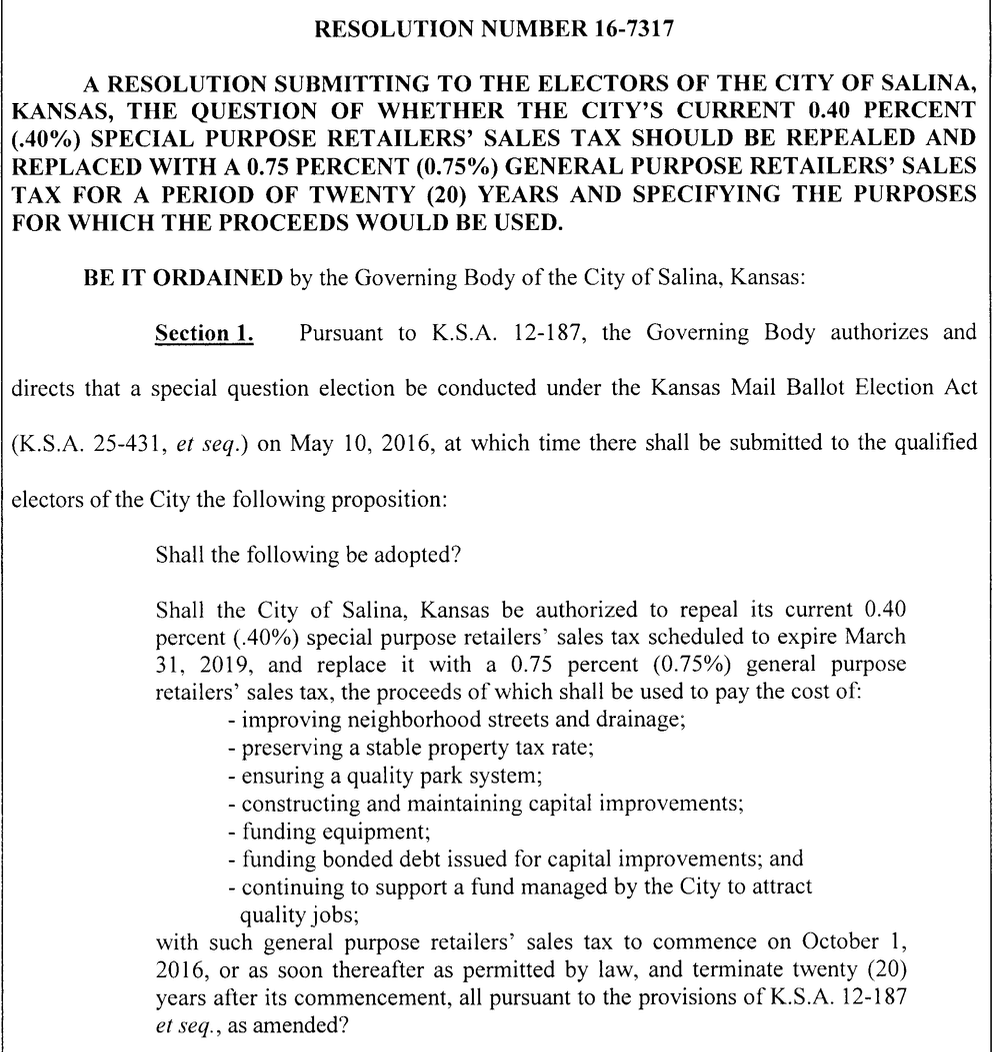
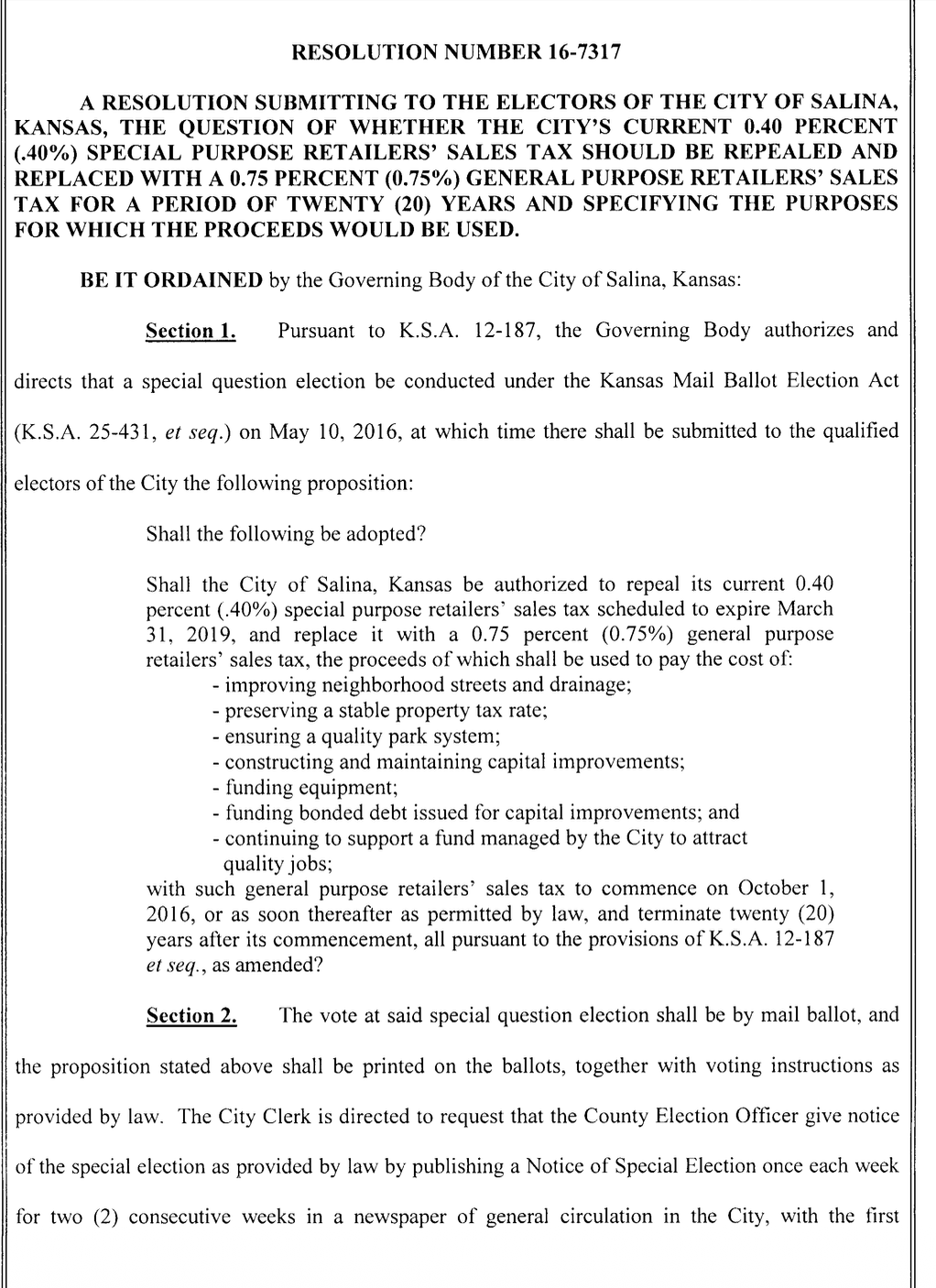
Resolution No. 16-7317 contains the proposition submitted to voters in the May 10, 2016 mail-ballot election.
The question asked whether the City should repeal its existing 0.40% special-purpose retailers' sales tax and replace it with a 0.75% general-purpose retailers' sales tax for 20 years.
The ballot stated that proceeds would be used to pay the costs of:
improving neighborhood streets and drainage;
preserving a stable property-tax rate;
ensuring a quality park system;
constructing and maintaining capital improvements;
funding equipment;
funding bonded debt issued for capital improvements; and
continuing support for a City-managed fund to attract quality jobs.
The terms “Smoky Hill River Renewal” and “river restoration” were not specifically included in that ballot proposition. The $1.35 million annual amount associated with River Renewal in City planning documents also was not included in the ballot language.
The ballot instead asked voters to approve or reject a general-purpose sales tax with the listed categories of allowable uses.
River Renewal was included in City planning before the 2016 vote
Other City records from January 2016 show River Renewal was among the projects being considered as officials developed the sales-tax proposal.
A City presentation titled “Special Purpose Sales Tax Future Considerations,” dated January 2016, listed several estimated future needs.
The presentation identified:
$1.6 million to $3.6 million annually for streets, bridges and trails;
$500,000 to $1 million for property-tax stabilization;
$400,000 to $600,000 for park rehabilitation and replacement;
$320,000 to $500,000 for economic development;
$1 million to $2 million for capital projects, facilities and equipment;
$150,000 to $300,000 for neighborhood redevelopment; and
$1.35 million annually for Smoky Hill River Renewal.
The combined estimated annual cost of the listed needs ranged from approximately $5.32 million to $9.35 million.
That record shows the $1.35 million River Renewal figure was being used by City officials during the planning process several months before the May 2016 election.
City staff called the river a priority in January 2016
A separate City Commission staff report prepared for the Jan. 25, 2016 meeting also addressed River Renewal.
The report said commissioners had discussed future community needs, including increased spending on neighborhood streets.
It also stated that “the renewal of the Smoky Hill River was also considered a priority project” because of the need to address channel restoration and provide a community amenity.
The report identified River Renewal alongside other priorities, including property-tax stabilization, park improvements, equipment and facilities, neighborhood investment and economic development.
River discussed at January 2016 commission meetings
The river also appeared in the minutes from public City Commission meetings in January 2016.
During the Jan. 11, 2016 meeting, Jane Anderson thanked commissioners for “considering the river in the mix” while commissioners and then-City Manager Jason Gage discussed possible sales-tax rates and future uses.
At the Jan. 25, 2016 meeting, then-Mayor Jon Blanchard said River Renewal “fulfilled the common vision” while also discussing streets, infrastructure and economic development.
Commissioner Trent Davis said during the same meeting that he did not believe there was “a better investment in the community than this tax.” Commissioner Karl Ryan discussed street conditions and the benefits of improving streets.
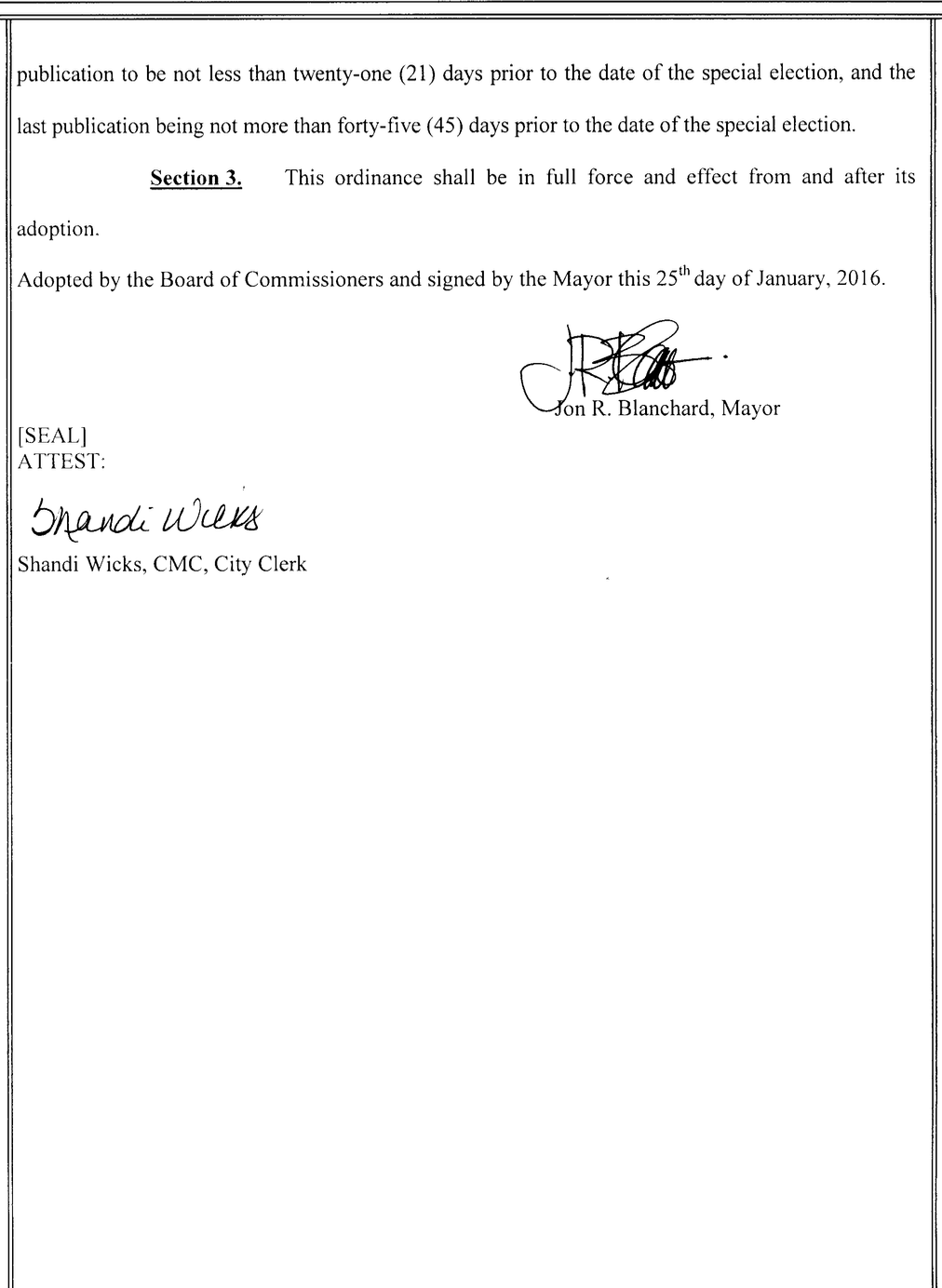
The commission voted 5-0 on Jan. 25, 2016 to submit the 0.75% sales-tax proposition to voters.
Planning documents and ballot used different levels of detail
Taken together, the records show different levels of detail at different stages of the process.
The City's January 2016 planning documents specifically identified Smoky Hill River Renewal and estimated $1.35 million annually for the project.
The May 10, 2016 ballot proposition, however, did not list individual projects or individual dollar allocations. It listed broader categories for use of the sales-tax proceeds.
The documents therefore support saying River Renewal was part of the City's planning and discussion surrounding the tax proposal, while the ballot itself did not establish a specific annual River Renewal appropriation.
Why a general-purpose tax was proposed
The January 2016 records also explain why the replacement tax was structured as a general-purpose sales tax.
City staff reported that bond counsel had advised that a special-purpose sales tax could not have the proposed 20-year term. According to the staff report, a general-purpose sales tax could instead be adopted with the proposed use restrictions and a 20-year sunset.
Staff said the longer period would allow the City to balance debt-service payments associated with large capital projects.
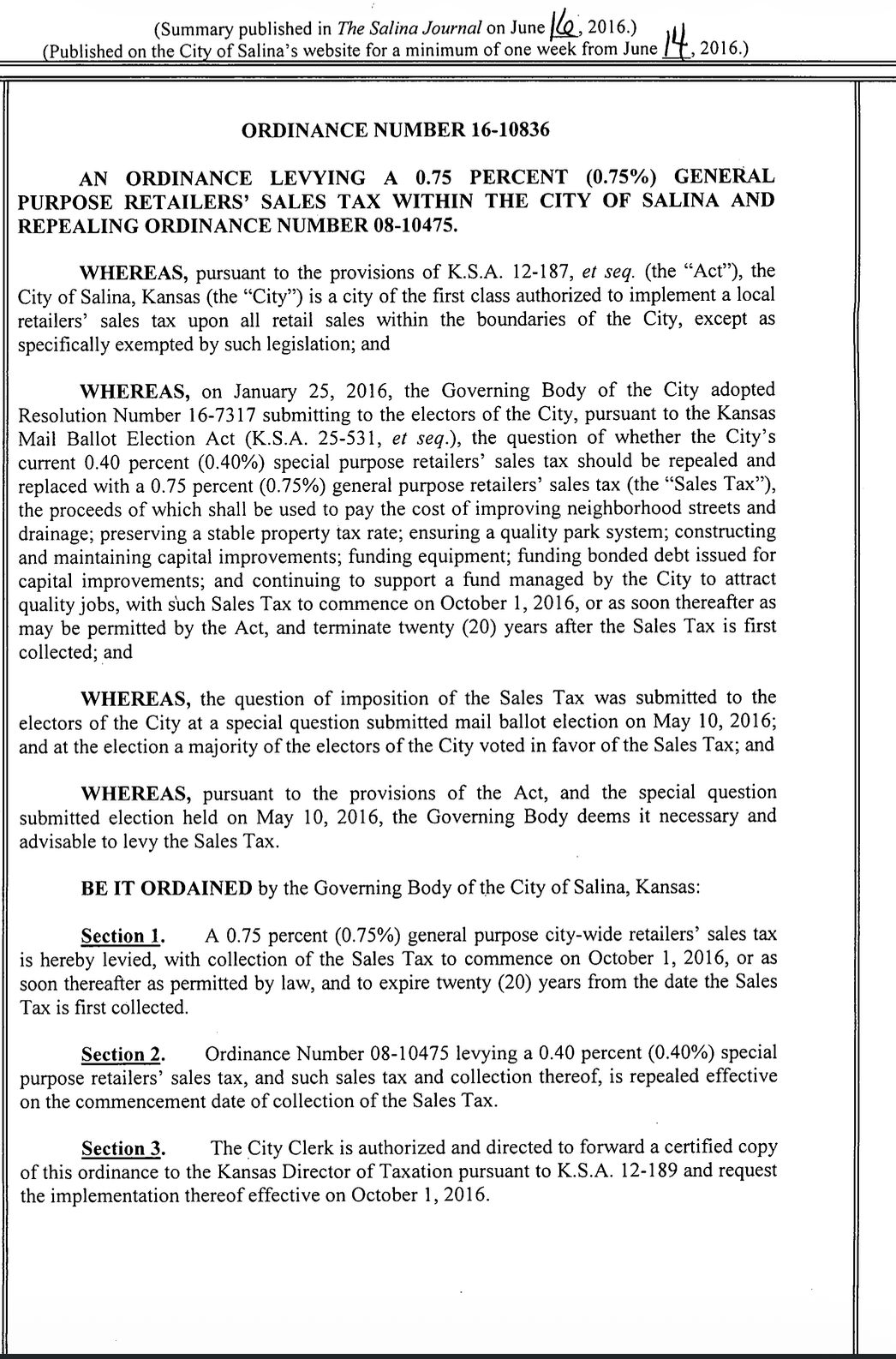
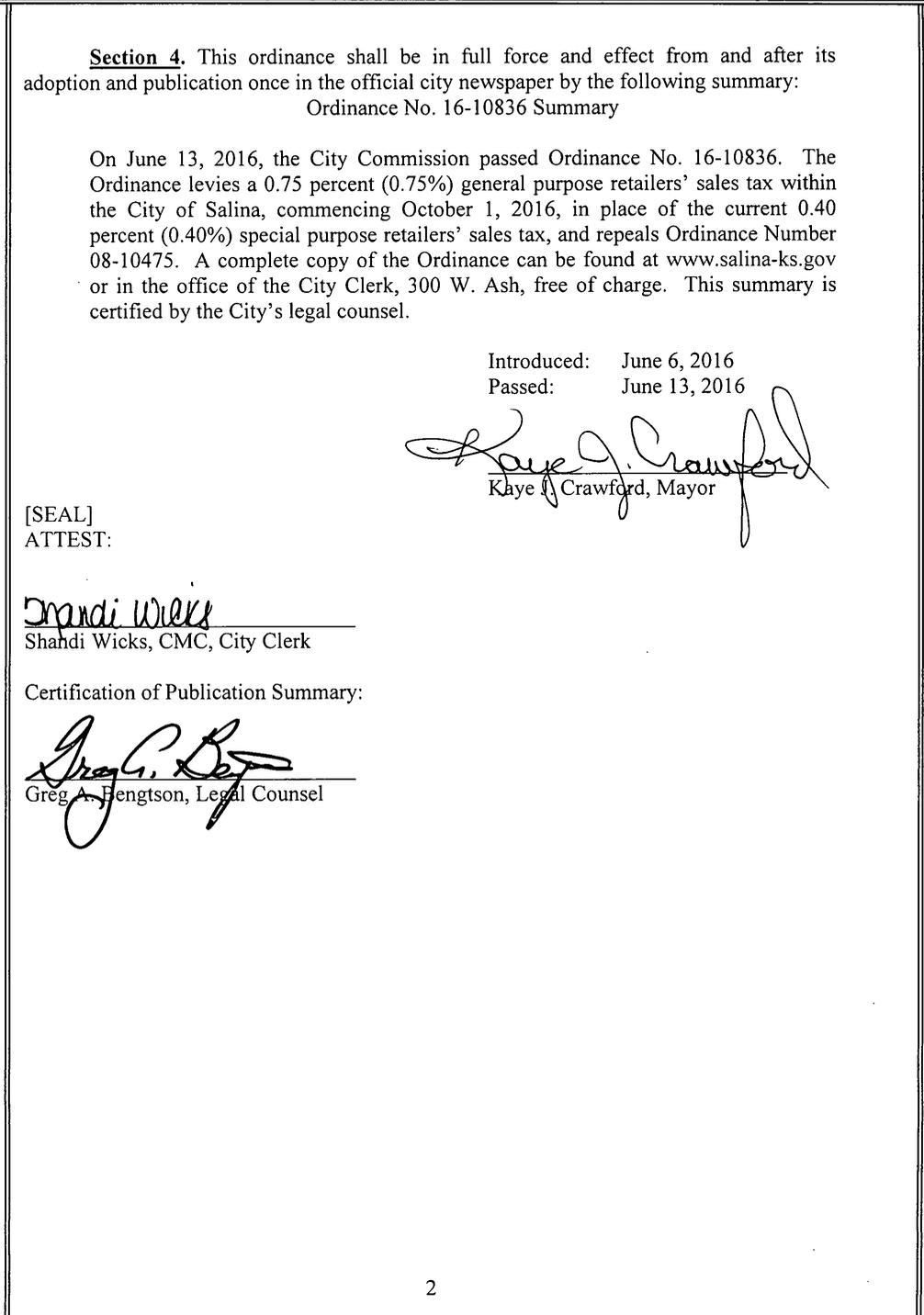
After voters approved the measure in May 2016, commissioners considered Ordinance No. 16-10836.
The ordinance formally described the tax as a 0.75% general-purpose citywide retailers' sales tax and listed the same broad purposes contained in the ballot proposition.
The City Commission approved the ordinance unanimously on first reading on June 6, 2016.
Commissioners approved it unanimously on second reading on June 13, 2016.
How the $1.3 million figure was later described
The City's current River Renewal information says a portion of the sales-tax revenue would support the project.
According to the City, approximately $1.3 million per year that had been used for Kenwood Cove debt service would be redirected to River Renewal after that debt was retired.
The City has calculated that $1.3 million annually over 16 years would produce approximately $20.8 million for River Renewal.
That amount is close to the $1.35 million annual estimate contained in the City's January 2016 sales-tax planning presentation.
The records reviewed do not show the $1.3 million or $1.35 million amount appearing in the actual May 2016 ballot proposition as either a required appropriation or a spending limit.
2026 Q&A identifies separate $5 million transfer
The new City Q&A published Aug. 17, 2026 identifies a separate source of local funding.
According to the City's response, commissioners discussed using general fund reserves and ultimately transferred $5 million from the general fund to support River Renewal.
The response does not state that the City's approximately $1.3 million annual sales-tax allocation was changed to $5 million per year.
Instead, the documents describe two different funding actions:
The approximately $1.3 million annual figure relates to the City's planned sales-tax support for River Renewal.
The $5 million figure identified in the Aug. 17, 2026 Q&A is described as a transfer from general fund reserves.
Project now includes multiple funding sources
River Renewal has since developed into several related projects with local, federal and private funding sources.
The City's current RAISE Grant 7 Bridges project is estimated at approximately $33.79 million, including about $22.11 million in federal RAISE funding and $11.675 million in City funding.
A separate U.S. Army Corps of Engineers aquatic ecosystem restoration project is currently estimated at approximately $21.315 million, including approximately $13.705 million in federal funding and a $7.61 million non-federal share.
Together, those two current published estimates total approximately $55.1 million.
That figure represents the City's published estimates for those two major components and should not necessarily be treated as an all-inclusive historical cost for every River Renewal-related expenditure.
The City's new Aug. 17, 2026 Q&A adds another detail to that funding history: the City Commission also transferred $5 million from general fund reserves to support the project.
The records from 2016 provide the earlier context. River Renewal was specifically discussed by City officials before the sales-tax election and was assigned an estimated annual need of $1.35 million in planning materials.
The proposition Salina voters actually received in May 2016, however, asked them to approve or reject a broader 0.75% general-purpose sales tax with several listed spending categories rather than a specific River Renewal appropriation.
Want this story in print?
We'll print this story on the cover and inside of a keepsake 4-page paper, then package it and ship it right to your door.
Sign in to save 10% — paid members save 20%.
