Salina Remembered: The Boy From Salina Whose Company Built America's Warplanes
Glenn L. Martin spent early childhood in Salina and later studied at Kansas Wesleyan. On Veterans Day, a look at the aircraft his company built for the men and women who served, from World War I bombers to the B-29 that ended World War II.
Millions of Americans who served in World War II never heard of a boy who once lived on the Kansas prairie outside Salina. But many of them flew, maintained or rode in the airplanes he built.
Glenn Luther Martin was born Jan. 17, 1886, in Macksburg, Iowa, to Clarence and Minta Martin. When he was 2, the family moved to Salina, where his father ran a wheat farm and worked as a traveling salesman, according to the Kansas Historical Society.
The family moved to Liberal when he was 6. It was there, the Historical Society says, that Martin began building box kites in the family kitchen and selling them to other boys for 25 cents apiece. He rigged a sail to a toy wagon to catch the Kansas wind, and later added sails to his bicycle and ice skates.
He came back to Salina as a young man. Kansas Wesleyan University's official history says Martin attended Kansas Wesleyan Business College, and the Historical Society says that's where he developed an interest in motorcars.
When word reached Kansas in 1903 that two brothers had flown a machine of their own invention, Martin searched the newspapers for anything about the Wright brothers. The Historical Society quotes what he told his mother when he found a picture of their flying machine: "Why this is just a kite with an engine in it. I can build kites, and I can build engines, so I am going to build one of these airplanes and fly it myself."
In 1905, the Martins moved to California. He learned the mechanic's trade and opened his own garage. For 13 months, he worked night after night in an abandoned church, building an airplane. On Aug. 1, 1909, he rolled it out to a nearby field and flew it. The Historical Society says that made him the third man to fly a plane of his own invention.
He made exhibition flights and set records. Kansas Wesleyan's history says that in 1911, Martin flew his self-built plane over southern Salina, near the campus. The Historical Society says he returned to Kansas for a series of barnstorming flights.
In 1912, he founded the Glenn L. Martin Aircraft Co. in Los Angeles.
Martin's company spent the next four decades building airplanes for the U.S. military.
In 1918, as World War I neared its end, Martin designed the MB-1, a twin-engine biplane bomber meant to outperform Britain's Handley Page. It first flew in August 1918, just weeks before the armistice, according to the Smithsonian's National Postal Museum. Lockheed Martin's company history calls it the first American-designed and American-built bomber purchased by the U.S. Army.
In the early 1930s, his company built the B-10, which Lockheed Martin's history calls America's first large all-metal monoplane bomber. The National Aeronautic Association awarded Martin the 1932 Collier Trophy, one of American aviation's highest honors, "for development of a high-speed weight-carrying airplane."
When World War II came, the Army needed more Martin bombers than the company's Baltimore plants could turn out. The government contracted with Martin in February 1941 to build and run an assembly plant at Fort Crook, near Omaha, Nebraska, according to History Nebraska, the state historical society. At its peak in November 1943, the plant employed 14,527 people, 40% of them women.
The Omaha plant built 1,585 B-26 Marauder medium bombers, History Nebraska says. Across all its plants, Martin produced 5,266 Marauders, according to the Smithsonian's National Air and Space Museum. The museum says B-26 crews flew more than 100,000 sorties, and the Army Air Forces lost fewer Marauders than any other Allied bomber it flew, less than one-half of 1%.
The Omaha workers then turned to building Boeing's B-29 Superfortress under license, turning out 531 of them, History Nebraska says.
Late in 1944, the Army Air Forces picked the Martin assembly line in Omaha to build a group of specially modified B-29s code-named Silverplate, according to the Air and Space Museum. One of them, serial number 44-86292, was named Enola Gay by its pilot, Col. Paul Tibbets, after his mother. On Aug. 6, 1945, it dropped the first atomic bomb used in combat, on Hiroshima, Japan. Three days later, another B-29 from the same plant, Bockscar, dropped the second, on Nagasaki. Japan announced its surrender days later.
The Enola Gay is now on display at the Air and Space Museum's Steven F. Udvar-Hazy Center in Chantilly, Virginia.
Martin's later companies grew into Martin Marietta, which merged with Lockheed in 1995 to form Lockheed Martin, one of the nation's largest defense contractors.
Back in Salina, Kansas Wesleyan named its football field Glenn Martin Stadium. The stadium, built with Works Progress Administration labor including Kansas Wesleyan students, was dedicated under his name in 1940. It served the university until it was torn down in 2014 to make way for the Graves Family Sports Complex.
Martin died Dec. 5, 1955. He was 69.
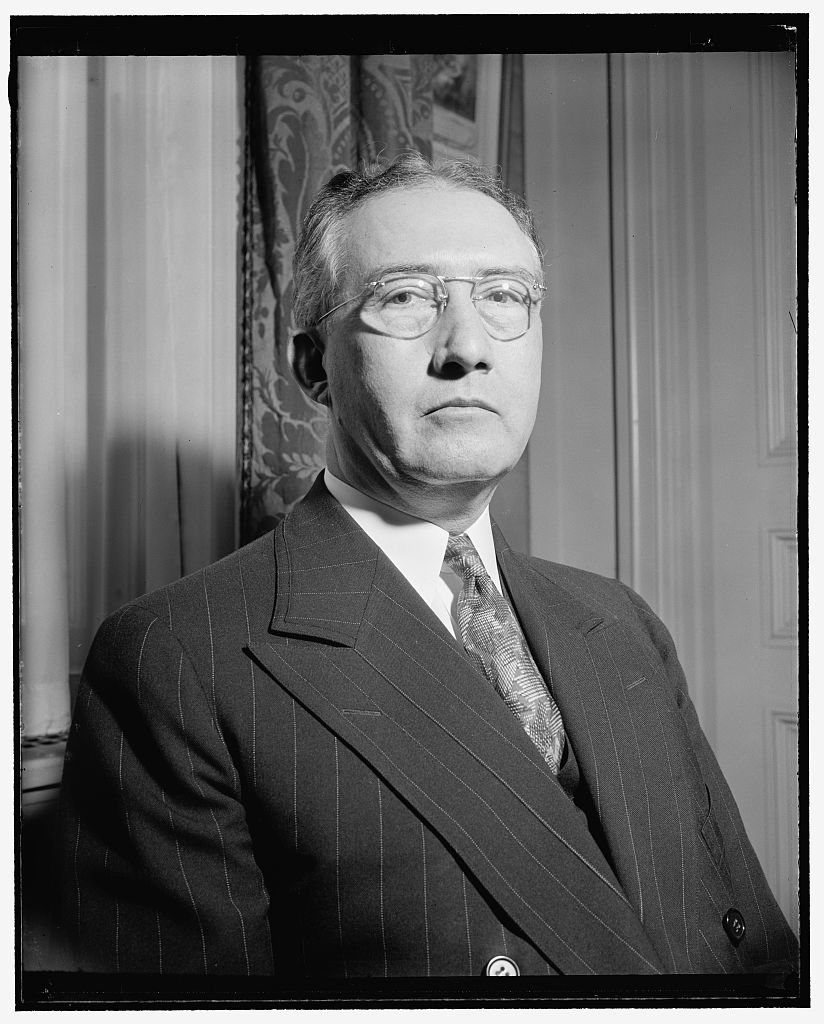
Aircraft manufacturer Glenn L. Martin, 1939. Photo: Harris & Ewing/Library of Congress