Salina commissioners lean toward traffic signal at Ohio and Schilling, despite consultant's roundabout pick
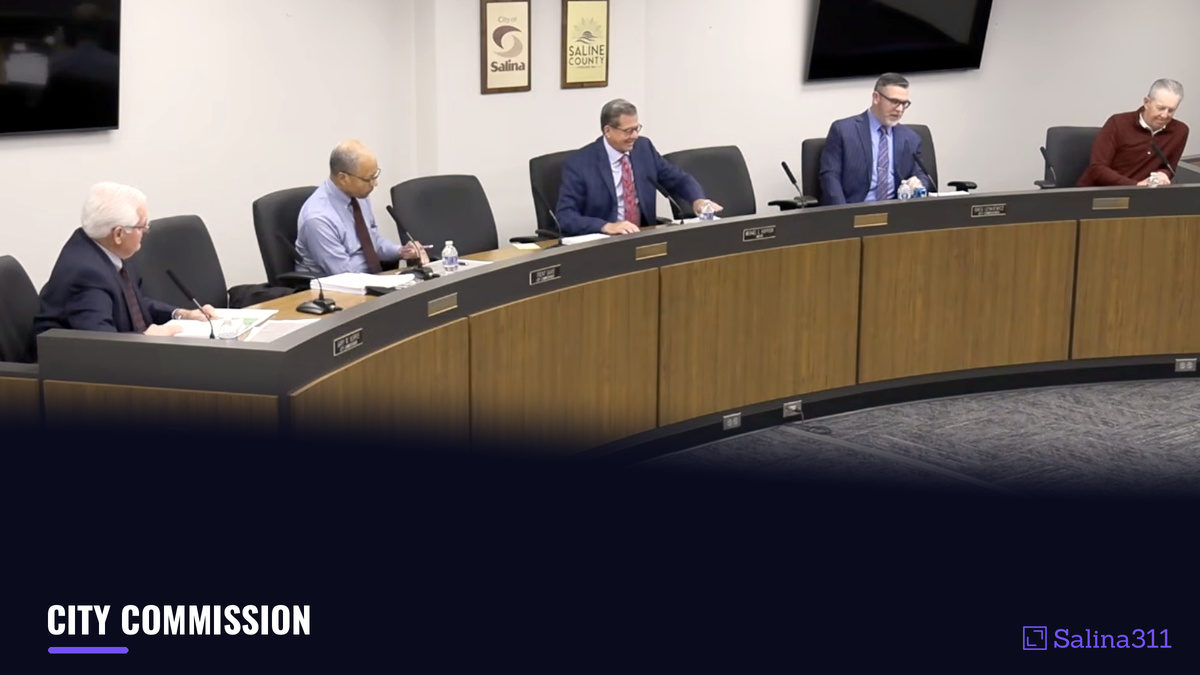
Salina city commissioners on Monday leaned toward a traffic signal for the South Ohio Street and East Schilling Road intersection, setting aside a consultant's recommendation for a "2+1" roundabout after nearly an hour of questions about pedestrian safety, older drivers and the community's limited experience with roundabouts.
"So do I hear a consensus for lights?" was asked as the 2:30 p.m. study session wrapped up. "I believe so, yes," came the answer.
The commission takes no formal action at study sessions. A city official told commissioners during the discussion that consensus on a direction was needed so the consultant could "go back and put together an estimate on the cost to design all of this," after which the city would return with another agreement to move forward with design.
Consultant recommends roundabout
Engineers from Benesch presented the study. Project manager Michael Heigert said the firm's cost estimates for the two finalists came out nearly even.
"The signal is about 3.8 and the roundabout was about 3.7, so they are pretty similar," Heigert said, referring to $3.8 million for a signal with added turn lanes and $3.7 million for the roundabout, according to the presentation.
"Our recommendation is going to be the roundabout on this one," Heigert said. "Really, a roundabout adapts as development occurs."
Heigert said all-way stop signs, which he said he believed were going in "now or soon," should work until about 2031, when traffic starts to break down. The firm projects a traffic signal would be warranted between 2036 and 2041, depending on development.
Traffic manager Jim Jussel said the intersection has had 11 crashes in the past five years, nine of them angle crashes and six with injuries. Its crash rate is 0.83 crashes per million entering vehicles, above the statewide average of 0.67 for that type of intersection, according to the presentation.
Benesch engineers said a signal would still allow right-angle crashes from drivers running red lights and would bring more rear-end crashes, while a roundabout would "totally eliminate the right-angle crashes, so you get a 90% reduction in the severe crashes." Heigert said the firm estimated about a 30% overall reduction in crashes with a roundabout.
The 2+1 design would have two lanes entering the roundabout on Ohio Street and one lane on Schilling Road. Engineers said that layout, managed by splitter islands, avoids the sideswipe problems of full two-lane roundabouts and would hold entry speeds to about 20 to 25 mph.
Commissioners raise safety concerns
Commissioner Trent Davis, who said he grew up with traffic circles in Washington, D.C., asked how the crash rate would change with a signal and whether speed limits would drop as the area develops. "This is an in-city intersection for all intents and purposes," he said.
Davis also asked about children crossing the road. Engineers said rectangular rapid flashing beacons could be added at crosswalks and that a roundabout's splitter islands let pedestrians cross in two stages, rather than crossing five lanes at a signal.
Later, Davis said, "If it wasn't for the residential, I would probably lean towards the roundabout." He said he would "probably go 51-49 roundabout, but that's a real shaky 51-49," and that pedestrian safety was enough to move him the other way.
"We're building houses out there, we're touting connectivity as one of our main housing themes, and I don't think this is going to enhance the connectivity," Davis said.
Commissioner Doug Rempp said he echoed most of Davis' comments. He called concerns about two-lane roundabouts "very legitimate," "especially when we have a lot of older drivers in the community," though he said the intersection would be better suited for a roundabout than Ninth Street and Water Well Road.
"It seems like every time we have an opportunity to put in a roundabout, we want to do it, and I certainly want to do it when they make sense," Rempp said.
Another commissioner said he was "cautious or leery of the dual lane roundabout when we have so little experience in roundabouts in our community," and said residents would likely be happier with a signal because "it's something they're used to around town."
During the discussion, another commission member said that if the commission "had to vote tonight it would be to signalize it because of the concerns." Another said, "I'm probably leaning towards the stoplight myself," citing foot traffic and the ability to time the lights to give more green time to Schilling Road traffic.
Commission members also noted that construction is planned for 2028, not a decade away. "This isn't a 10-year wait-and-see project," one said.
Commissioner Greg Lenkiewicz said roundabouts "are more intuitive than they seem on paper," and that he was not concerned about pedestrian crossings. But he said a roundabout would bring added costs for buying right-of-way on the corners, and that the commercially zoned land around the intersection could become a convenience store, a gas station or a strip mall.
"Maybe with those unknowns, the signal intersection is a better solution for us," Lenkiewicz said. "Philosophically, I'm not opposed to the roundabout."
Budget gap
The city's 2027-2031 capital improvement plan, adopted Oct. 12, budgets $2 million in 2028 for a roundabout at the intersection, paid for with general obligation bonds, according to the plan. That is below both of Benesch's estimates.
Ohio Street is a four-lane road with a 40 mph speed limit north of Schilling and a two-lane rural road with a 45 mph limit to the south, according to the presentation. East Schilling is a gravel dead-end road that serves as the only access to Johnson Sand Co., and the Quail Meadow Estates neighborhood sits southeast of the intersection.
Salina311 previously reported the consultant's recommendation in Roundabout recommended for Ohio Street and Schilling Road, with all-way stop first.