
Hoppock Warns Crowd on Decorum as Shelter Euthanasia, KORA Complaints and Defense Costs Take Center Stage
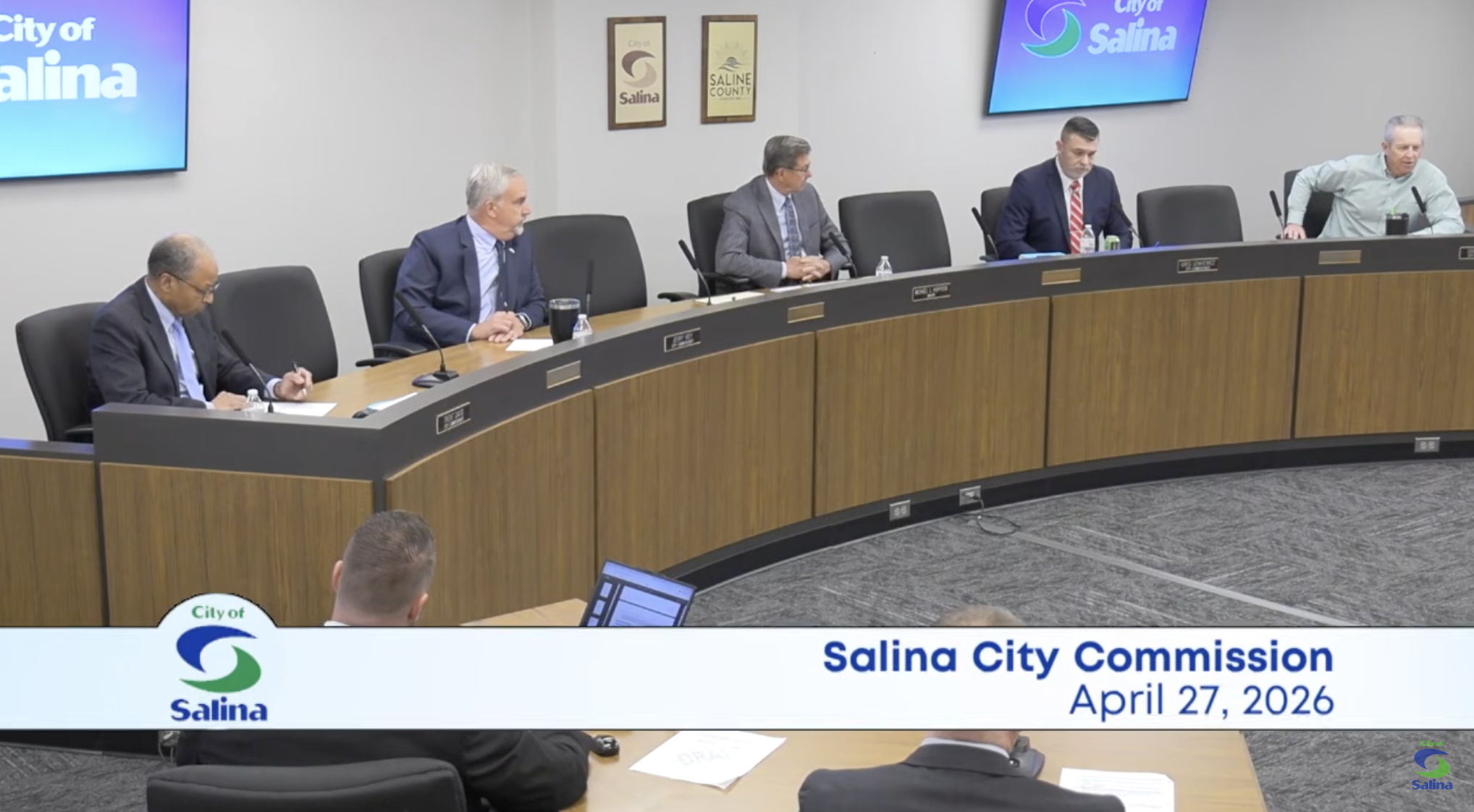

Before opening citizens forum at Monday’s Salina City Commission meeting, Mayor Mike Hoppock told attendees the city would more strictly enforce the three-minute public comment limit and warned that disruptions from the audience would not be allowed.
Hoppock said the meeting clock does not make a sound when time expires, so he would call time and ask speakers to wrap up within five to 10 seconds.
“We’ve been letting some comments go long, and it’s not fair to allow someone to go four minutes when somebody’s tried to keep their comments to three,” Hoppock said.
Hoppock also addressed conduct at the previous meeting, saying things had gotten “a little out of hand.”
“The demeanor of the public was, in my eyes, not acceptable,” Hoppock said. “You get your three minutes. You come up, you can say what you want, how you want. We don’t have to agree with it. That’s fine.”
Hoppock said anyone disrupting the meeting from the audience could be escorted out by an officer.
“If we’re disruptive in the audience, we do have an officer here,” Hoppock said. “We will have you escorted out. We’re not going to deal with that anymore. That was an embarrassment to the community.”
As Hoppock finished the warning, someone in the audience appeared to shout toward him. The remark was difficult to hear clearly on the recording, but appeared to include the word “embarrassment.”
Hoppock then asked for the person to leave.
“She can leave, please,” Hoppock said. “We just talked about it. Yes, please. I’m sorry. We will respect you. I expect you guys to respect us also.”
The commission then opened citizens forum.
Much of the public comment period focused on continuing concerns over the Salina Animal Shelter, including euthanasia practices, shelter leadership, open records requests and the city’s decision to provide legal defense funding for two shelter employees facing criminal charges related to animal cruelty allegations.
Christy Dixon Parham of Salina criticized the city’s shelter leadership and questioned the April 2 euthanasia of seven pit bulls at the Salina Animal Shelter.
Parham said she understood euthanasia can sometimes be necessary, but said the issue was whether every reasonable option had been exhausted before the animals were euthanized.
“The issue is whether every realistic, reasonable effort was made before that decision was reached to euthanize those seven dogs,” Parham said.
Parham said outside rescue organizations were reportedly willing to take the dogs, but alleged those phone calls were not returned.
“Why would a shelter choose euthanasia over a phone call?” Parham said. “Why would animals lose their lives when there were organizations willing to step in?”
Parham also referenced previous efforts to promote animals through Salina311’s “featured animal of the week” platform, saying outreach opportunities should be used when they could help animals find homes.
Kathy Schwartz of Salina spoke about Rose Base, the former Salina Animal Shelter director. Schwartz said Base was hired as an animal control officer in 1986, became shelter director in 1993 and helped guide the creation of the current shelter, which opened in July 2000.
Schwartz said Base and others had tried for more than two years to bring concerns about the shelter to city leaders.
“Meeting after meeting, you have been made aware of serious concerns and have chosen not to act,” Schwartz said. “This is not inaction. It is a decision.”
Schwartz said residents, taxpayers and donors have a right to know how the shelter is being operated and said animals are suffering the consequences of delayed action and ignored warnings.
Rosemary Mice of Salina encouraged commissioners to visit animal shelters in Clay Center and Manhattan. Mice said she had recently toured both and was especially impressed with the Clay Center facility.
Mice said the Salina shelter building itself had been praised for its design and filtration system, but urged city leaders to look at how other shelters are operated.
“I encourage the commissioners maybe to take a run over to Clay Center and Manhattan and talk to these directors that they have there and see how their shelters are run,” Mice said.
Sue Nickel criticized the decision to use taxpayer dollars to fund the criminal defense of two shelter employees. She argued the city’s justification depended on the claim that the employees acted within their official duties and in good faith, but said records showed shelter policy and veterinary protocol were not followed.
Nickel referenced an email she said was sent by Andrea Murphy to the state of Kansas and argued the shelter’s policy allowed intraperitoneal euthanasia for cats, birds and pocket pets, but did not authorize intracardiac euthanasia for dogs.
“Show me where in this policy the intracardiac euthanasia is allowed in dogs,” Nickel said. “It’s not there. It’s not mentioned. It’s not authorized. It’s not permitted.”
Nickel also referenced the early 2026 state inspection of the shelter and said the state required euthanasia to stop unless performed by a licensed veterinarian.
The discussion then shifted to Kansas Open Records Act requests. Nickel questioned City Attorney Patrick Hoffman about the cost estimate for emails, saying she had been quoted $1,020 for five days of emails before the estimate was later reduced to $512.
Hoffman said the city had received more than 40 KORA requests since March and said some requests require legal review because of personal information, employee information and possible redactions.
“When I get a KORA request, some, they don’t all come to me, but the ones that do, I have a duty to charge people for my time on it, because that’s taxpayer money that is funding my salary,” Hoffman said.
Hoffman said the initial estimate was based on roughly 2,500 pages of records. After an initial review, he said he determined much of the material was repetitive or related to prior KORA requests, which allowed the city to reduce the estimate.
Hoppock then addressed complaints filed with the Kansas Attorney General’s Office over the city’s handling of open records requests.
Hoppock said seven complaints had been filed against the City of Salina alleging Kansas Open Records Act violations. He said that, on the first three complaints, the Attorney General’s Office asked the city to take steps to better inform requesters when records would be provided if the city could not complete a request within three business days.
Hoppock said there was no formal enforcement action and that those complaints were considered closed.
“There was no formal enforcement action, and the Attorney General considered the complaint closed,” Hoppock said.
Hoppock also said complaints dated March 23, March 27, April 2 and April 8 resulted in findings that the city had not violated KORA and that no formal enforcement action was warranted.
“According to the Attorney General, the city did not violate KORA and no formal enforcement action is warranted,” Hoppock said. “The cases have been closed.”
Hoppock said the city was following the law and said some redactions are required.
“We’re doing what we’re allowed to do by law,” Hoppock said. “Sometimes redactions are required.”
Michelle Thames of Minneapolis spoke next and accused city staff of making statements that did not match the documented record.
Thames referenced prior statements regarding whether shelter euthanasia had been stopped out of “an abundance of caution,” whether sedation was part of the shelter’s euthanasia process and whether the puppies euthanized in December were sedated.
“These are not misunderstandings,” Thames said. “These are documented contradictions between what was said and what the records show.”
Thames said city leadership had opportunities to correct the record when those statements were made.
“Truth is not flexible,” Thames said. “Truth is not negotiable.”
Rose Base also spoke and quoted from Salina311’s March 6 interview with Dr. Melissa Juby, the city’s contracting veterinarian.
Base referenced Juby’s statement that the shelter’s humane euthanasia standard operating procedure was based on the Humane Society of the United States euthanasia reference manual, and that intracardiac euthanasia is an approved method only for unconscious animals.
Base also quoted Juby as saying she contacted Parks and Recreation Director Jeff Hammond, Operations Superintendent Andrea Murphy and Animal Services Manager Monique Hawley within about one hour of learning concerns about the reported use of a heart-stick procedure without sedation.
According to the quoted statement, Juby directed that no shelter staff administer euthanasia while the matter was being addressed and that euthanasia be performed by Juby or another licensed veterinarian.
The citizens forum reflected the continued pressure facing city leaders as the shelter controversy moves across multiple fronts, including animal welfare concerns, public records disputes, legal defense funding, criminal proceedings and broader questions about city oversight.
No final action on the shelter issue was taken during the citizens forum portion of the meeting.