
Why We Built Fractals From Salina311, and What It Means for Salina & Other Communities
By Matt Moody
Back in January, we quietly moved Salina311 onto the Fractals Platform.
We did it quietly on purpose. There were still bugs to work out, workflows to tighten, and rough edges to smooth down. There still are. But the foundation is now strong enough that it makes sense to say clearly what we built, why we built it, and where it is going.
The first thing people should understand is this: Salina311 was the model Fractals was built on.
Fractals did not come out of a startup whiteboard session disconnected from the real world. It came directly out of the work we were already doing in Salina. The founding team, myself and Joshua Barnhart, built Fractals because the traditional platforms available to local publishers and community builders could not do what we wanted them to do. They were too rigid, too fragmented, too dependent on outside algorithms, and too limited in the ways they handled local participation, local data, local events, and local distribution.
So we built it ourselves.
I have never believed local information should depend on whether people happen to scroll past the right Facebook post or remember to check a stale website. If something matters in the community, whether that is a public meeting, a major local story, a trend in the data, an event, a public safety issue, or a question residents are actively debating, it should be easy to find, easy to understand, and easy to receive.
That is what Fractals is for.
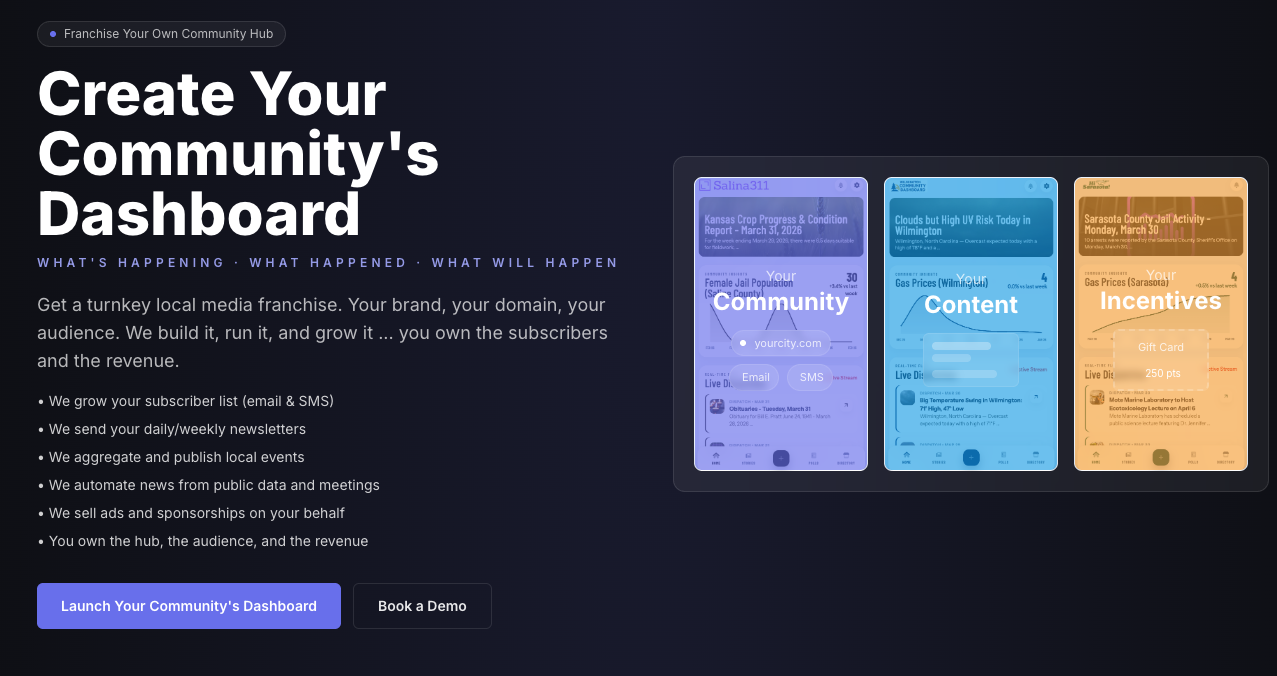
Fractals is the platform underneath Salina311 now, but it is bigger than one site. It has expanded rapidly into 16 communities across 8 states: Kansas, North Carolina, Missouri, Kentucky, Alabama, Arkansas, Florida, and Washington.
Today that network includes Salina311 in Salina, Community Dashboard in Wilmington North Carolina, LeesSummit311 in Lee’s Summit, Oldham Voice in Oldham County KY, MountainBrook311 in Mountain Brook AL, NEA311 in northeast Arkansas, The JeffCo Journal in Jefferson County MO, HiSarasota in Sarasota FL, PalmCoast321 in Palm Coast and Flagler County FL, ColbyJournal in Colby, and The Bellevue Brief in Bellevue. (We also have 6 more locations launching in KS communities in the coming weeks).
What matters to me is that this is not a centralized media conglomerate trying to manufacture “local” coverage from far away. Each Fractals location has a different owner or operator. The model is much closer to a federation, people in different communities who care about surfacing relevant local information for local residents. The technology is shared. The mission is shared. But the communities are not being flattened into one voice.
That distinction matters. Local information works best when the people running it actually care about the place, understand what residents worry about, and know the difference between noise and signal. Fractals is designed to support that kind of local ownership while giving operators much better tools than the old patchwork most local sites have been stuck with.
For Salina311, that means we can do much more than post stories. We can surface community metrics that help show the direction of the city and county. We can track and publish datapoints that help residents gauge real progress, drift, or trouble. We can gather community feedback. We can organize local events. We can publish polls that people actually use, with the network now seeing roughly 8,000 votes per day on average. We can make it easier for residents to participate instead of just passively consuming whatever the algorithm decides to show them.
It also means locals can participate directly. Community members can create events. They can submit stories. They can respond to polls. Over time, I want that participation layer to get much deeper, because local information should not be a one-way broadcast. It should be an ongoing exchange between the people gathering information and the people living inside it.
One of the most important pieces of Fractals is distribution. We are building toward a local information system where people can get the stories, data, events, and updates they care about directly by email and by SMS. That way, staying informed does not require sitting on Facebook, babysitting a feed, or repeatedly browsing websites that may or may not have been updated. If something is important locally, the system should be able to push it to people in a direct, non-annoying, and useful manner.
We are also continuing to expand the kinds of information we surface. That includes more local data, more useful civic indicators, and broader public accountability coverage. A big part of that is public meetings. My view is simple: if a public body is making decisions that affect local residents, those meetings should be covered in a way normal people can actually follow. We are building workflows around agendas, meeting documents, audio, video, and summaries so that more public meetings can be surfaced and understood without residents having to dig through government websites on their own.
That same approach applies across the board. We want more relevant stories, more usable data, better event participation, better feedback loops, and better tools for understanding what is happening in a community right now. We are still refining the product, still fixing bugs, and still improving the workflows, but we are confident about the direction.
Salina311’s move to Fractals was not just a backend switch. It was a return to the platform that was built from Salina311’s own needs in the first place. And now that platform is helping power a growing network of locally owned community information sites across multiple states.
See more at FractalsNetwork.com