
Salina Still Needs More Than 1,600 Housing Units by 2030, Even After Recent Building Push
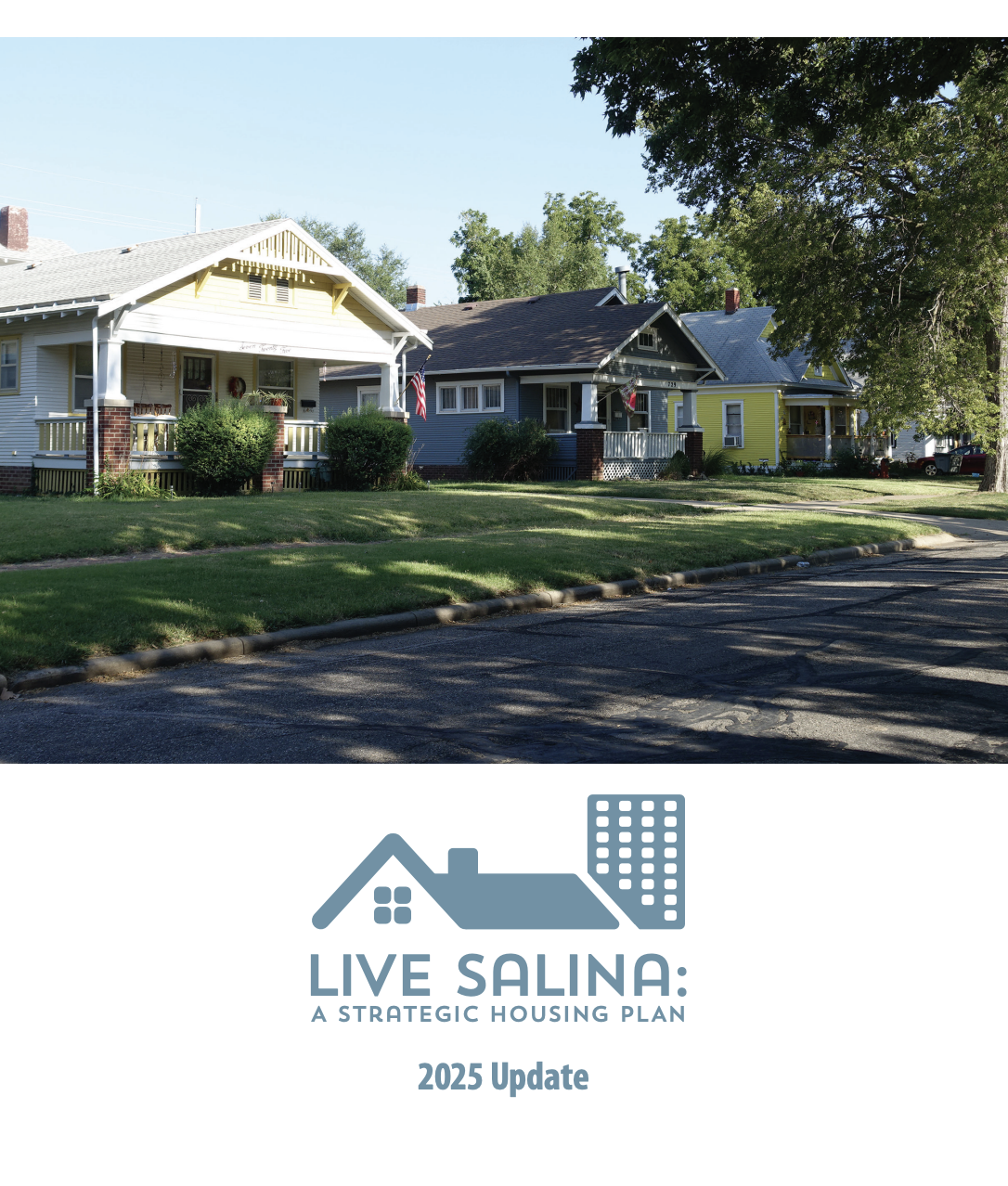
City officials say incentives have helped produce more than 1,000 units, but the next phase may be harder: lower-cost ownership, rentals, infill housing and future public-private financing.
Salina’s housing strategy is producing new units, but city documents and a recent housing study session show the community still faces a sizable gap through 2030.
The 2025 Live Salina update projects a need for 1,645 additional housing units from 2025 through 2030, including 905 owner-occupied units and 740 rental units. That works out to an average construction need of about 274 units per year. The projection includes demand tied to existing and future job openings, population growth, replacement needs and target vacancy rates.
During the May 11 City Commission study session, staff described an even larger working number. According to the study-session transcript, the city must take the estimated 1,645 units needed for the next wave and add 201 units that have not yet been completed. That brings the total cited during the meeting to 1,846 units by 2030. The math is straightforward: 1,645 plus 201 equals 1,846.
The difference between those two numbers is one of the key questions coming out of the update. The written Live Salina supplement identifies the formal projected need as 1,645 units. The study-session discussion suggests the city may be working from a broader number when unfinished units are added back in. That distinction matters because it affects how much housing the city believes still needs to be built, what kind of incentives may be considered, and how aggressively the city may need to pursue new development tools.
Housing Production Has Increased, But Demand Remains
The city’s May 11 packet says Salina has partnered with developers since the 2021 Live Salina supplement to support construction of more than 400 new owner-occupied homes and more than 500 new rental units. The packet also states that the city’s efforts have expanded beyond greenfield development to include infill and neighborhood stabilization work.
During the study session, staff described the city’s recent housing work as producing more than 1,000 units when looking across the city’s major incentivized projects and grant-backed housing work. Those projects discussed included Cedarhurst, South View Estates, Aero Plains, Salina Destination, now known as Magnolia Village, CDBG housing work and Federal Home Loan Bank-backed infill efforts.
The study-session transcript said Phase 1 of Magnolia Village, formerly Salina Destination, includes 250 garden-style apartment units and was at full occupancy within days of units becoming available. Staff said the final building was coming online, with all units already leased before residents had moved in.
That absorption is one reason city staff said the market is still showing demand, even after recent construction.
Vacancy Rate Depends on What Is Actually Available
The Live Salina update says the 2023 American Community Survey estimated Salina’s vacancy rate at 7.5%. However, the city’s analysis excludes categories such as “other vacant,” vacation homes and units that have been rented or sold but are not yet occupied. After those categories are removed, the effective vacancy rate used for projection purposes is about 3.1%.
That distinction is important. A house may technically be counted as vacant, but that does not mean it is available to a new household. Some vacant units may be tied up in repairs, legal issues, occasional use, foreclosure or other circumstances that keep them from functioning as available housing.
The study-session transcript also records staff saying that desirable homes have recently sold quickly, often within 24 to 48 hours, and that available inventory has remained tight. Staff said current market numbers showed roughly 90 to 98 listings, with a significant share coming from incentivized projects. The transcript also records staff saying that without those incentivized listings, the remaining market would include only a limited number of homes in the city’s middle price range.
Because that inventory discussion came from a transcript and staff noted they do not have direct MLS access, those numbers should be treated as a current market snapshot rather than a formal city dataset.
The Hardest Gap Is Still Lower-Cost Ownership
The Live Salina update breaks down the projected 2025-2030 need by price point. For owner-occupied housing, the largest need is in the lowest ownership category: 466 units under $225,000. The plan also projects a need for 151 units between $225,000 and $300,000, 180 units between $300,000 and $400,000, and 109 units above $400,000.
The study-session transcript says staff sees a surplus in the $225,000 to $300,000 ownership range, which staff described as a workforce housing category the city had intentionally incentivized. However, staff also said the biggest unmet ownership need remains under $225,000.
The written update also cautions that the price ranges are based on 2023 data and likely need to be adjusted upward because of inflation, construction costs and interest rates. The report states that the under-$225,000 category may now be closer to under $250,000 in current market terms.
For rental housing, the plan projects a need for 199 units under $625 per month, 210 units between $625 and $1,000, 199 units between $1,000 and $1,500, and 132 units above $1,500.
During the study session, staff said the city had made progress in the $625 to $1,000 rental range, also described as a workforce housing target. Staff said the rental strategy can help households that may not be able to buy in the lower-cost ownership category but still need housing when moving to Salina.
Public Incentives Remain Central to the Strategy
The study-session transcript included a summary of the city’s housing incentive picture since 2021. Staff said the city has roughly $32.9 million in housing investment over an estimated 25-year window, mostly through taxes the city will forego through tools such as industrial revenue bonds and Rural Housing Incentive Districts. Staff also said the city has secured about $29.6 million in outside revenue or grant funding for housing, creating a difference of about $3.3 million.
That calculation lines up mathematically: $32.9 million minus $29.6 million equals $3.3 million.
However, the comparison should be read carefully. The $32.9 million figure appears to include long-term tax revenue the city expects to forego over many years. The $29.6 million figure appears to include grants and outside funding brought in to support housing projects. Foregone future tax revenue is not the same as an immediate cash payment from the city budget, but it is still public value being assigned to housing development.
That distinction will matter as the city considers future housing tools. The May 11 packet says adopting the Live Salina updates has no direct cost, but the findings may inform future policy decisions, including possible financial incentives or programs to support housing development. The draft resolution also says the updated Live Salina Plan would serve as a guide for reviewing requests for public or private financing, incentives and land-use applications.
In other words, the adoption itself does not spend money. But the plan may become the policy basis for future spending, tax incentives or public-private financing requests.
Infill Housing Is a Slower, More Complicated Piece
The city’s written packet says the 2024 North Salina Housing Scenarios study reviewed the feasibility and cost of rehabilitating existing homes and building new infill housing. The analysis looked at single-family rehabilitation, accessory dwelling units, new single-family infill construction and “missing middle” housing types. The packet says the study identified significant financial gaps between development costs and achievable market values.
During the study session, staff said the city started infill housing work in 2024, ahead of the plan’s original timeline. Staff identified North Salina as a primary focus area and said the city is using CDBG and Federal Home Loan Bank funding for rehabilitation work.
According to the transcript, the Federal Home Loan Bank grant was just under $1 million, with a goal of improving 44 homes over four years. Staff also said the city has $300,000 in CDBG funding working on 12 to 14 homes.
The challenge is that many homes need more work than those programs can cover. Staff said many houses needing help require around $50,000 in repairs, while many programs max out at $20,000 to $30,000. In some cases, staff may inspect a property and find more than $100,000 in needed work, making the home too expensive for the program to realistically address.
That creates a policy tension. Public funds can help preserve older housing stock and keep homes from sliding into demolition. But the work may also involve investing public dollars into private homes while residents are still living in them, with the expectation that the improved housing stock will benefit the broader community over time.
Future Tools Could Include Different Housing Types and Infrastructure Financing
The study-session transcript shows city officials discussing additional housing types, including smaller homes, manufactured housing, townhomes, duplexes, cottage courts and other “missing middle” options. Staff said the city may need to adjust incentive policies to encourage different types of housing if the market begins offering new models.
The written Live Salina update also points to demand for more diverse housing types, including duplexes, townhomes and small-lot single-family units.
Infrastructure may also become a larger part of the next housing discussion. Staff said future conversations may include financing methods and perimeter road policies, especially for greenfield development where roads, water and sewer infrastructure can affect whether new housing can move forward.
A Data Point That Needs Clarification
One table in the Live Salina update appears to need clarification. Figure 14 shows a target new-construction distribution by housing type for 2025-2030. The table lists total demand as 1,645 units, but the totals by type shown in the table are 214, 457, 493 and 451. Those four numbers add to 1,615, leaving a difference of 30 units.
That may be the result of rounding, draft formatting or a table-entry issue. The broader plan still clearly identifies 1,645 units as the projected total need. However, because the document is being used to guide housing policy and future incentive decisions, the city should clarify which numbers control future planning.
Bottom Line
The latest housing update presents two realities at the same time.
First, Salina’s housing incentive strategy appears to be producing results. The city has supported hundreds of owner-occupied and rental units, major apartment projects are being absorbed quickly, and staff says recent housing programs have contributed to more than 1,000 new units.
Second, the city is not done. The written plan still projects 1,645 units needed by 2030, while study-session discussion placed the working need at 1,846 units after accounting for unfinished units. The hardest remaining gaps appear to be lower-cost ownership, affordable rentals, infill rehabilitation, and housing types that are less expensive than traditional new single-family construction.
The next phase of Salina’s housing strategy may not be whether incentives worked. The more difficult question is what public tools the city is willing to use next, how much public value those tools require, and whether the resulting housing reaches the price points where the need is still greatest.