
Commissioner Rempp Calls Attention to River Project Costs, Water Conditions as Work Advances
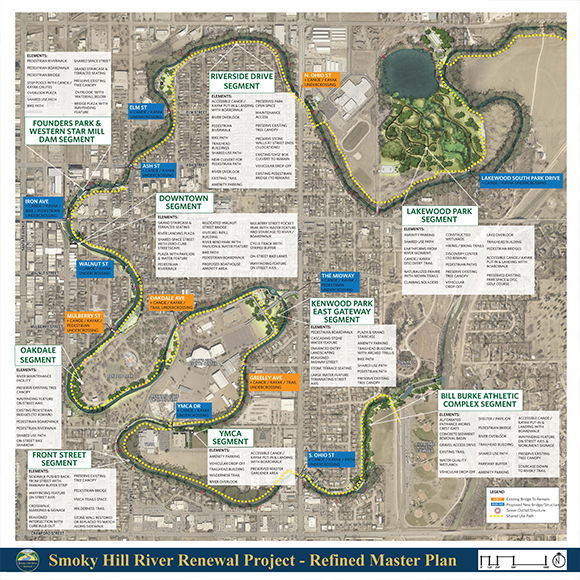
As Salina continues advancing the Smoky Hill River Renewal Project, the cost of the work and the region’s water conditions are becoming part of the same public discussion.
Commissioner Doug Rempp said in an email to Salina311 that he believes the full project could reach tens of millions of dollars in today’s costs. His comments followed recent city action tied to property acquisition and came after he reviewed water-supply information that he said raises concerns about long-term river conditions in central Kansas.
The river renewal effort has developed over more than a decade through separate planning, funding and construction phases. The City of Salina adopted the Smoky Hill River Renewal Master Plan in 2010. That same year, voters rejected a dedicated river-only sales tax proposal. In 2016, voters approved a broader city sales tax increase, with a portion of that money later tied to river renewal projects.
City project materials state that the 2016 sales tax was expected to generate about $20.8 million for the Smoky Hill River Renewal Project after Kenwood Cove debt service was retired. The city also states that the project has been divided into multiple components, including local design and trail work, a federal RAISE-funded bridge and trail project, and a U.S. Army Corps of Engineers restoration component.
Official city materials list the RAISE/7 Bridges project at $33,787,620, including $22,112,620 from the RAISE grant and $11,675,000 from the City of Salina. That project includes seven bridges, multi-use trails, lighting, pedestrian improvements, a multimodal hub, retaining wall work, a maintenance facility, boat ramps, boardwalk elements and related improvements.
The city’s USACE restoration project page lists a separate estimated total of $21,315,000 under the General Investigations program. That figure includes a $13,705,000 federal share and a $7,610,000 non-federal share identified as the City of Salina cost.
Together, those two listed city project components total about $55.1 million. That figure does not by itself establish the final local taxpayer cost because federal funding, city funding, sales-tax revenue, private fundraising, land acquisition, engineering, and future maintenance are separate parts of the overall financing structure.
Recent city documents also placed estimated property acquisition costs to date at $1,414,845. That amount includes HDR acquisition and appraisal review services, just compensation for real property and easements, appraisal services, survey review, title insurance and closing costs.
The city documents state local funding for the city’s portion of the River Renewal Project comes from a $1.3 million per year sales tax allocation, a $5 million General Fund transfer, private funding through Friends of the River, and possible downtown STAR Bond funds.
Rempp said the scale of the project and future maintenance costs should remain part of the public discussion as the project moves from planning into land acquisition and construction.
“This project may have been viable a decade ago, but now seems to me to be a perhaps 50 million dollar gamble not factoring any upkeep dollars,” Rempp wrote. “Starting about now, the dollars are going to get real.”
Rempp also pointed to a 2019 Annual Water Conference report that discussed Salina’s location near a shifting climate boundary between wetter and drier regions of the country.
The paragraph cited by Rempp described Salina as a city near the 97th Meridian and stated that if climate models are correct, Salina is “at the heart of the migrating climatic boundary” and could experience increasing aridity and drought as the boundary continues moving east. The report also noted that Salina’s water supply sources are split between surface water from the Smoky Hill River and groundwater from wells located in the Smoky Hill River alluvium.
Broader climate research has also examined the eastward movement of the historic humid-arid boundary of the Great Plains. A 2018 summary from Columbia Climate School described research finding that the traditional 100th Meridian divide appears to be shifting eastward, closer to the 98th Meridian.
The City of Salina’s own project materials describe the old channel as having no sustained base flow and accumulated sediment. The city also says it has obtained a water right to divert a portion of Smoky Hill base flows into the old channel, but that sedimentation and undersized culverts make restoration work necessary.
The water-supply connection is one part of the project’s stated purpose. City materials describe the river renewal effort as a utility project intended to rejuvenate the river ecosystem for sustainable water management. The USACE restoration component is described as work intended to reestablish flows within the 6.8-mile river corridor, restore degraded habitats, and provide new water-based recreational opportunities.
Friends of the River also describes restoration of water flow as the foundation’s main goal. Its project page says the old river channel became a silted-in riverbed with almost no flow after the river was diverted in 1961.
Current water data adds context to the discussion. The National Weather Service reported Salina at 4.58 inches of precipitation since Jan. 1, compared with a normal 8.52 inches, a deficit of 3.94 inches. Since March 1, Salina had received 2.30 inches, compared with a normal 6.94 inches.
Drought.gov listed 20,244 people in Saline County as affected by drought, representing 36.4% of the county population. It also listed January through April 2026 as the 31st driest year-to-date period for Saline County over the past 132 years.
USGS data for the Smoky Hill River near Mentor showed a May 17 instantaneous discharge of 23.7 cubic feet per second. The median discharge for May 17, based on 85 water years of record at that gauge, is 172 cubic feet per second.
Reservoir data also shows below-normal levels at key regional lakes. USGS reported Kanopolis Lake at 1.30 feet below conservation pool on May 17. Wilson Lake was listed at 5.72 feet below conservation pool.
The renewed discussion does not change any formal action already taken by the city. The Salina City Commission has continued approving project-related steps, including property acquisition and agreements tied to the river corridor.
The project continues to be promoted by the city and Friends of the River as a long-term effort involving river restoration, bridges, trails, public spaces, recreation, downtown development and waterway improvements.
Rempp’s comments place cost, maintenance and long-term water conditions into the same discussion as the project moves toward construction. Current city materials show the work has grown into a multi-source project with federal, local and private funding components, and with listed project elements now totaling well above $50 million across the major RAISE and USACE components.