
Sponsored: Response to Steven Howe on the Industrial Revenue Bond Legislative Audit
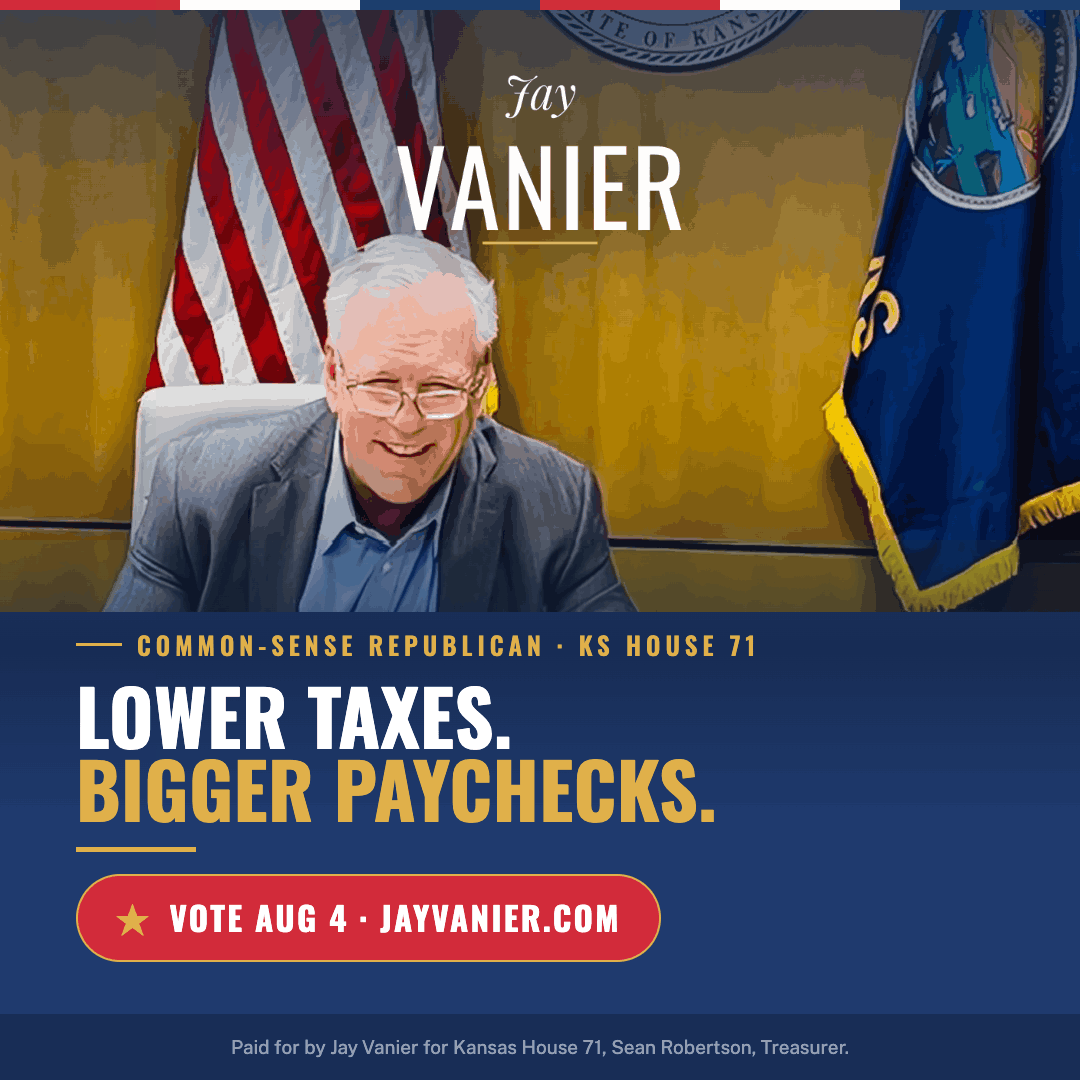
By Jay Vanier
In response to the recent legislative audit of industrial revenue bonds, one of the economic development tools Kansas cities and counties use to attract and expand businesses, Rep. Steven Howe wrote:
“I have been fighting against this mentality and version of ‘economic development’ for years. We can’t continue to give away the ‘farm.’ Businesses do not survive long if they give away their value, so why does government do this? Kansas offers a lot of value and advantages for doing business here. Let’s act like it and change our posture.”
I agree that Kansas has many advantages. We have hardworking people, a strong agricultural heritage, a central location, excellent transportation networks and communities that are great places to live and raise a family.
However, I respectfully disagree that simply changing our “posture” will make Kansas more competitive.
Industrial revenue bonds are only one economic development tool. Like any incentive, they should be judged by whether they produce measurable benefits for taxpayers, not by slogans or assumptions.
The facts tell a more complicated story. Among the four states surrounding Kansas, Nebraska, Oklahoma, Missouri and Colorado, Kansas has the highest commercial property tax rates, the highest state sales tax rate and the second-highest residential property tax rates. Those are real costs that businesses and families consider when deciding where to invest, expand or relocate.
The results also deserve attention. From 2010 to 2025, Kansas’ population grew by 3.9%, well behind several neighboring states. Nebraska and Oklahoma, two states with economies and demographics similar to Kansas, each grew by more than 10% during that period. Over the past five years, Oklahoma has grown at roughly three times the rate of Kansas.
That did not happen because Oklahoma and Nebraska simply changed their posture. They made deliberate policy choices to compete for jobs, investment and residents.
Oklahoma uses programs such as the Quality Jobs Program, invests in industrial site readiness, partners with CareerTech to develop a skilled workforce and aggressively recruits employers and investment.
Nebraska has invested in workforce housing through its Rural Workforce Housing Fund, prepared industrial sites for development and used targeted economic development tools to attract businesses and residents.
The recent legislative audit of industrial revenue bonds deserves careful consideration. The audit did not conclude that IRBs are simply “giving away the farm,” as Howe suggested.
Instead, auditors explained that the actual fiscal effect falls somewhere between zero and the estimated amount of foregone property taxes because no one can determine with certainty how many projects would have occurred without the incentives.
The audit also found that Kansas needs stronger cost-benefit analysis, greater transparency, improved oversight and better follow-up to compare promised results with actual outcomes.
Those are legitimate concerns, and they should be addressed.
Kansas should never approve an industrial revenue bond, or any other economic development incentive, without accountability. Every project should demonstrate a measurable public benefit, and every incentive should be reviewed to determine whether taxpayers received a reasonable return on their investment.
However, I do not believe the answer is to reject economic development tools that neighboring states are using to attract businesses that might otherwise locate elsewhere.
Kansas already has higher commercial property taxes, a higher state sales tax and some of the highest residential property taxes in the region. Simply declaring that our existing advantages are enough is not a growth strategy.
If we want to reduce the property tax burden on homeowners, we must grow the commercial and industrial tax base. That means attracting employers, creating jobs, expanding private investment and increasing the number of taxpayers sharing the cost of local government.
Successful projects eventually become taxable. After a property tax abatement expires, the community can be left with a larger commercial property tax base than it had before.
The real question is not whether incentives exist. It is whether they produce enough long-term jobs, private investment and tax-base growth to justify their temporary cost. That should be the standard Kansas applies to every project.
Kansas has tremendous strengths, but our economic performance shows those strengths alone are not enough. If they were, Kansas would not have one of the region’s highest business tax burdens while neighboring states continue to outperform us in attracting people, jobs and investment.
I am a builder, not a blocker.
Kansas should use every responsible economic development tool available, including industrial revenue bonds when appropriate, along with other proven strategies to grow our economy, broaden the tax base and reduce the long-term property tax burden on Kansas families.
We should compete aggressively, demand accountability, measure results and protect taxpayers.
Those goals are not in conflict. They are how Kansas wins.
Paid for by the Jay Vanier campaign, Sean Robertson, Treasurer.