
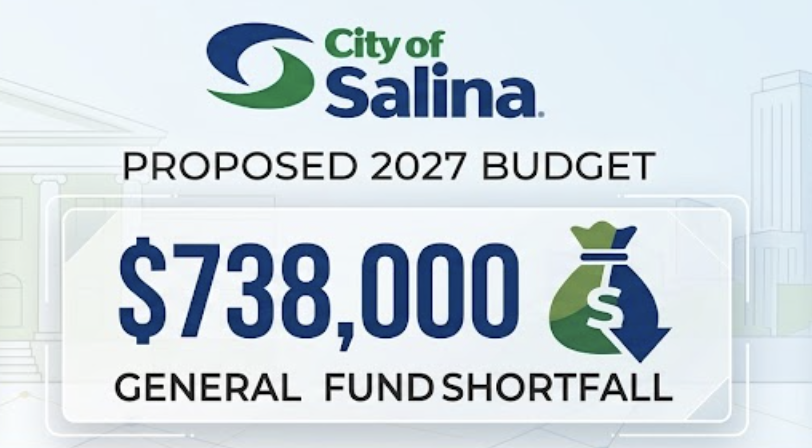
Salina’s Proposed 2027 Budget Carries $738,000 General Fund Shortfall as Tax Deadline Approaches
Commissioners are considering collecting more property-tax revenue while also approving employee raises, higher health-insurance costs and increased outside-agency funding
SALINA, Kan. — The City of Salina is developing a proposed 2027 budget that currently carries an estimated $738,000 General Fund shortfall, even after assuming the city will collect more property-tax revenue than it would under the revenue-neutral rate.
The working budget already assumes the city will retain its prior-year property-tax rate, provide employees with a 1.5% cost-of-living adjustment and up to a 1.5% merit increase, raise health-insurance premiums by 5% and provide outside agencies with the full amounts they requested. It also relies on several transfers from other city funds.
The budget has not been finalized, and commissioners have not yet formally adopted a property-tax rate.
Property-tax decision remains unresolved
The city’s revenue-neutral rate for 2027 is 27.526 mills. That is the rate that would allow the city to collect approximately the same amount of property-tax revenue as the previous year, despite growth in property values.
The city’s prior-year rate was 28.568 mills.
Keeping that rate would not increase the mill levy itself, but it would allow the city to collect approximately $605,000 more property-tax revenue than it would under the revenue-neutral rate because Salina’s overall property valuation has increased.
Staff presented four options:
| Option | Mill rate | Revenue effect |
| Revenue-neutral rate | 27.526 | Slightly more than $16 million |
| Keep prior-year rate | 28.568 | About $605,000 above revenue neutral |
| Increase prior-year rate by one mill | 29.568 | Nearly $1.2 million above revenue neutral |
| Rate intended to cover the General Fund shortfall | 29.836 | About $1.3 million above revenue neutral |
The city’s adjusted taxable valuation is approximately $570.9 million, an increase of about 4.23% from the previous year. The overall valuation before tax-increment financing districts, housing incentive districts and pending exemptions are removed is approximately $582.8 million.
What must happen by July 20?
By July 20, the City of Salina must notify the Saline County clerk whether it intends to exceed the revenue-neutral rate.
The city must also provide the highest proposed mill rate it may consider using. After that rate is submitted and published, commissioners may lower it during the remainder of the budget process, but they cannot raise it above the published amount.
That means the commission could publish a rate of 29.568 or 29.836 mills and later reduce it to 28.568. It could not publish 28.568 mills and later decide to increase it to 29.568.
If the city exceeds the revenue-neutral rate:
The county clerk will send notices to taxpayers.
The city must hold a public hearing.
Commissioners must adopt a resolution authorizing the city to exceed revenue neutrality.
The final budget must be submitted to the county by approximately Oct. 1.
If the city stays at the revenue-neutral rate, the budget must be adopted and submitted by approximately Aug. 25.
Effect on homeowners
Staff illustrated the options using a home appraised at $200,000.
| Option | Estimated annual effect |
| Revenue-neutral rate | About $24 less |
| Keep current rate | Approximately no rate-related change |
| Current rate plus one mill | About $23 more |
| Rate to address the shortfall | About $29.17 more |
The approximately $29.17 increase would equal about $2.43 per month.
Those examples assume the home remains appraised at $200,000. A homeowner whose property valuation increased could still pay more even if the city keeps the same mill rate.
Commissioners lean toward exceeding revenue neutrality
Commissioners generally supported retaining at least the prior-year rate of 28.568 mills, meaning the city would exceed revenue neutrality and collect additional property-tax revenue.
Commissioner Trent Davis said he would rather increase taxes than reduce vital services. He acknowledged that increases can affect residents on fixed incomes but said the city must pay for services and infrastructure.
Commissioner Jerry Ivey indicated support for keeping the current mill rate and said he could potentially support an additional mill if necessary.
Commissioner Greg Lenkiewicz also leaned toward retaining the current rate but remained open to a higher rate, citing concern that future state legislation could restrict cities’ ability to increase property-tax revenue.
Commissioner Doug Rempp said he could support the current rate but would not support increasing the mill levy above that amount. He argued that commissioners should distinguish between necessary spending and projects the city merely wants.
No final rate was selected.
Employee raises
The proposed budget includes:
A 1.5% cost-of-living adjustment for city employees.
Up to a 1.5% merit increase based on performance.
Staff estimated that each 1% cost-of-living adjustment costs the General Fund approximately $316,000.
Each 1% merit increase costs approximately $162,000 because merit increases occur on employees’ anniversary dates rather than being awarded to every employee at the beginning of the year.
Using those estimates, the proposed 1.5% cost-of-living adjustment and 1.5% merit program would cost approximately $717,000 combined.
Commissioners supported including both adjustments in the proposed budget.
Staff said personnel accounts for approximately 70% of city expenses.
Officials said previous pay-plan changes increased annual costs but improved the city’s ability to hire and retain employees, particularly in police, fire and streets. The city continues to experience hiring difficulties in utilities and landfill operations.
Health-insurance premiums
The city is self-insured and pays employee health claims through a city health-insurance fund.
The fund ended 2025 with approximately $2.5 million, below its minimum target balance of about $2.9 million.
The city considered 5% and 10% premium increases.
A 5% increase would cost employees approximately:
$7 more per month for individual coverage.
$16 more for employee-plus-one coverage.
$19 more for family coverage.
A 10% increase would approximately double those amounts.
Under the 5% option, the city projects that the health fund could lose about $175,000 during 2027. A 10% increase was projected to produce approximately $225,000 in net income but would cost the General Fund another $196,000 because the city pays roughly 80% of employee premiums.
Commissioners supported the 5% increase.
Staff initially said the city’s stop-loss insurance threshold was $250,000 but corrected the figure at the end of the meeting. The actual 2026 threshold is $200,000, up from $175,000.
Transfers from other city funds
The proposed budget moves additional sales-tax and reserve money into the General Fund.
The transfers include:
| Proposed transfer | Amount |
| Additional one-time tax-stabilization transfer | $300,000 |
| Money previously intended for debt service | $650,000 |
| Building and facility fund transfer | $300,000 |
| Kenwood Cove fund transfer | $100,000 |
| Increase in recurring sales-tax stabilization transfer | From $1 million to $1.2 million |
The building and facility fund reportedly contains approximately $1.3 million. The Kenwood Cove fund contains approximately $200,000.
City sales-tax collections were running about 5.3% above the previous year through May, compared with budget projections of approximately 4% to 4.5% growth.
Several of the proposed transfers are one-time moves. They can reduce the 2027 shortfall but do not permanently address recurring expenses.
Outside-agency funding
The proposed budget also includes the full amounts requested by outside agencies.
General Fund requests would increase by approximately $63,058, including:
Salina Grace increasing from $90,000 to $100,000.
OCCK increasing from $1,011,150 to $1,061,708.
Sky Fire increasing from $12,500 to $15,000.
Salina Liberty remaining at $35,000.
Salina Tennis, the Municipal Band and United Way remaining unchanged.
Other requests would be paid through dedicated sales-tax or transient guest-tax funds.
Visit Salina requested an increase from $750,000 to $950,000. Cultural Marketing funding would fall from $150,000 to $50,000, while Community Marketing would remain at $240,000.
Commissioners reached a consensus to leave all of the requested amounts in the proposed budget, although the funding will not become final until the budget is adopted.
General Fund reserves
The city ended 2025 with approximately $26 million in General Fund reserves.
That amount is projected to fall to approximately $21 million after planned 2026 spending, including construction of the new fire station.
The city’s reserve target is $15 million.
Staff said the city could use reserves to close the shortfall for one year but cautioned against using reserves to pay recurring annual expenses.
Water rates will be handled separately
The budget discussion did not establish new water rates.
Staff said water operations are funded through a separate enterprise fund and that the outside-agency allocations do not come from the water fund.
Water rates, utility projects and water-system financing will return to commissioners in a separate discussion before rates must be adopted at the end of the year.
Final decisions remain ahead
The proposed budget currently:
Carries an estimated $738,000 General Fund shortfall.
Assumes the city will exceed the revenue-neutral rate.
Includes employee raises and higher health-insurance premiums.
Uses one-time and recurring transfers from other city funds.
Funds outside agencies at their requested amounts.
Leaves open the possibility of increasing the mill levy above the prior-year rate.
The immediate decision is whether the city will formally notify the county by July 20 that it intends to exceed revenue neutrality and what maximum mill rate will be published.
The final tax rate and complete 2027 budget will be decided later in the budget process.