
Cozy Inn Case Update: Salina Shifts Legal Argument as Commissioners Meet Behind Closed Doors
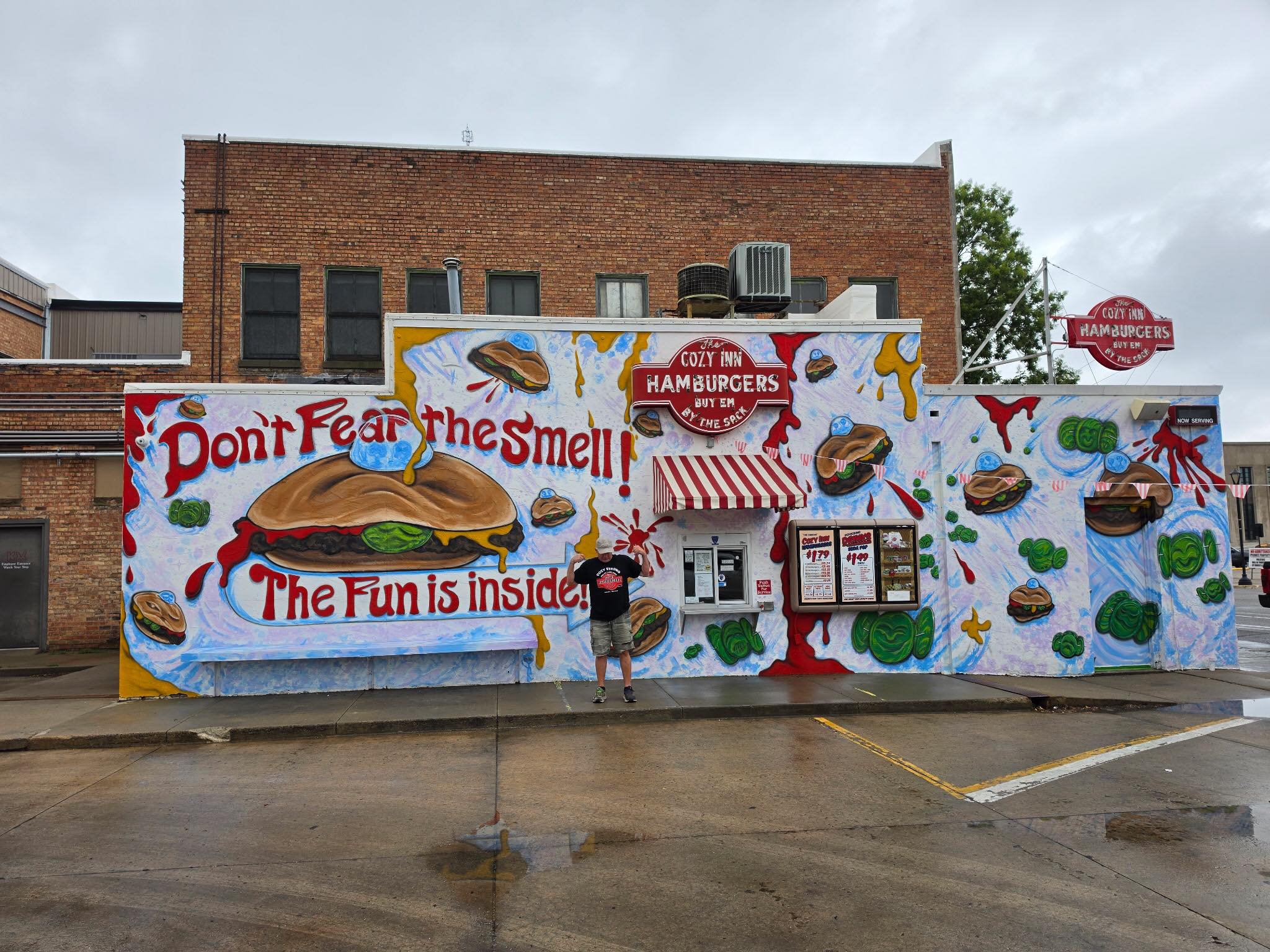
Salina Leans on Different Legal Framework in Cozy Inn Mural Appeal
City argues its sign rules are content-neutral and supported by a Supreme Court ruling, expert testimony and codes used in other communities.
The City of Salina is defending its sign code under a different First Amendment framework than the “commercial speech” explanation city officials emphasized when the Cozy Inn mural controversy began in 2023.
In its pending appeal before the U.S. Court of Appeals for the Tenth Circuit, Salina argues that its definition of a sign is a content-neutral regulation governing the time, place and manner of outdoor displays. The city is asking the appellate court to reverse a federal judge’s ruling that Salina’s distinction between regulated signs and unregulated murals violated the First Amendment.
The city is not asking the court to approve a newly written ordinance. It is asking the court to reinstate and uphold the existing definition of “sign” contained in Section 42-764 of the Salina Municipal Code.
Legal Emphasis Moves Away From Commercial Speech
When city officials initially discussed the Cozy Inn mural, their public explanations frequently centered on the distinction between commercial and noncommercial speech.
Court records include statements from then-City Manager Mike Schrage describing the important distinction as one involving commercial speech and the city’s authority to regulate commercial signs. The city’s position was that a mural related to products or services offered by the business could be treated as a sign, while an unrelated artistic display would generally remain an unregulated mural.
That is not the primary legal theory Salina is advancing in its appeal.
Instead, the city argues that its written definition applies to any exterior display used to “announce, direct attention to, or advertise,” regardless of the particular topic, idea or viewpoint expressed. Salina maintains that the definition is content-neutral on its face and should therefore be reviewed under a legal standard known as intermediate scrutiny.
Intermediate scrutiny generally gives governments more flexibility than the strict scrutiny standard applied to laws that regulate speech based on its subject or message.
The Cozy Inn’s appellate attorneys point out that Salina is not asking the Tenth Circuit to decide the case under the traditional commercial-speech doctrine. They argue that the city is instead attempting to defend the same enforcement decision by placing it under a different First Amendment category.
City Relies on Supreme Court’s Austin Decision
A central part of Salina’s appellate argument is the 2022 U.S. Supreme Court decision in City of Austin v. Reagan National Advertising.
That case involved different rules for on-premises and off-premises signs. The Supreme Court found that examining a sign to determine whether it referred to something located on the same property did not automatically make the regulation content-based.
Salina argues that its definition is similar because it regulates a display according to whether the display functions as something that announces, directs attention or advertises, rather than according to whether the city agrees with its message.
The city maintains that its sign regulations serve broader government interests, including traffic safety, aesthetics, property values and reducing excessive sign clutter.
The Cozy Inn argues that the Austin case is materially different. Its attorneys contend Austin involved a location-based distinction, while Salina’s inspectors must examine and interpret the content of a mural to decide whether it advertises or relates closely enough to a business’s products to become a regulated sign.
Under the Cozy Inn’s position, the same painting could be legal on one business but regulated on another. A hamburger-themed mural could potentially be treated differently when painted on a restaurant than when painted on a business that does not sell hamburgers.
Salina Points to Codes Used in Other Cities
Salina is also relying on the experiences and sign codes of other communities to argue that its approach falls within established municipal planning practices.
The city retained urban planning and zoning attorney Mark White as an expert. According to Salina’s appellate brief, White examined 21 sign codes, including codes used by comparable communities in Kansas and Oklahoma.
Salina also presented evidence that dozens of municipalities, including New York City and Cincinnati, use the same or substantially similar language when defining a sign. The city argues that those comparisons, along with expert testimony and industry materials, demonstrate that its definition is consistent with common national practices.
The use of similar language in another community does not, by itself, establish that Salina’s application of the code is constitutional. The legal question is not limited to the words appearing in the ordinance. It also includes how those words were interpreted and applied to the Cozy Inn mural.
The Cozy Inn argues that Salina still must read and interpret a display’s message before deciding whether the sign code applies. Its attorneys maintain that this makes the regulation content-based, even when the ordinance does not expressly identify particular subjects or viewpoints.
Federal Judge Found Salina’s Evidence Insufficient
U.S. District Judge Toby Crouse ruled in November 2025 that Salina’s mural-sign distinction failed even under intermediate scrutiny.
The court did not ultimately decide whether the distinction was content-based or content-neutral. Instead, the judge assumed the more favorable intermediate standard applied and concluded that Salina had not demonstrated that its policy was sufficiently tailored to its stated interests.
The court found that Salina had not adequately explained why a mural connected to products sold by a business would create greater safety or aesthetic concerns than other large murals.
The ruling specifically questioned why a baseball mural at a baseball-related business or a music-themed mural associated with a music business would avoid the alleged harms while the Cozy Inn’s hamburger-related display would not.
The court declared Salina’s mural-sign distinction unconstitutional and found that the city imposed an unconstitutional prior restraint by placing owner Stephen Howard’s permit application on an indefinite hold rather than issuing a timely approval or denial.
However, the decision was not a complete victory for the Cozy Inn.
The judge rejected the claim that the word “advertise” was unconstitutionally vague, finding that the term could be understood by an ordinary person. The court also declined to issue the broad permanent injunction requested by the Cozy Inn, concluding that declaratory relief was sufficient based on the evidence presented.
City Also Challenges Prior-Restraint Finding
Salina’s appeal addresses more than the constitutionality of the sign definition.
The city also disputes the finding that it imposed an unconstitutional prior restraint by holding Howard’s permit application. Salina argues that keeping the application open was intended as a courtesy while city officials explored possible code changes or another solution.
The district court rejected that argument, finding insufficient evidence that Howard voluntarily agreed to an indefinite delay. The judge noted that Salina’s ordinance generally required permit decisions within 10 days, while Howard’s application had remained unresolved since November 2023.
Appeals Court Declines to Pause Ruling
Salina requested that the Tenth Circuit temporarily stay the district court’s declaration that the sign definition was unconstitutional while the appeal remained pending.
On May 6, a two-judge appellate panel denied that request. The brief order did not decide the full appeal but found that Salina had not demonstrated that the factors required for a stay weighed in the city’s favor.
The city filed its opening appellate brief on February 23. The Cozy Inn filed its response on March 25, and Salina filed its final reply brief on April 15. Several national organizations have also filed friend-of-the-court briefs supporting the Cozy Inn’s position.
Commissioners Continue Closed-Door Discussions
The Salina City Commission held a special meeting July 15 to consult with special legal counsel regarding the Cozy Inn case.
The city’s public notice stated that commissioners would enter executive session for attorney-client consultation and could take action after returning to open session. The commission did not announce a new public decision following the session.
The substance of the commissioners’ discussion remains confidential under attorney-client privilege.
What Happens Next
The Tenth Circuit could uphold the district court ruling, reverse it or send portions of the case back to the district court for additional proceedings.
Both Salina and the Cozy Inn have requested oral arguments. No oral-argument date appears on the publicly indexed docket, although that docket was last retrieved from the federal system on June 1 and may not contain more recent scheduling entries.
The central issue remains whether Salina’s definition regulates signs according to their neutral function or whether officials must examine a display’s subject and relationship to the business before deciding whether the sign code applies.
Salina says its definition is a standard, content-neutral planning tool supported by Supreme Court precedent, expert testimony and widespread municipal practices.
The Cozy Inn says the city is continuing to regulate identical artwork differently based on what the artwork depicts and who displays it.
The Tenth Circuit will determine which interpretation controls.