Decades of Salina Research Help Unlock Genome of Potential Perennial Crop
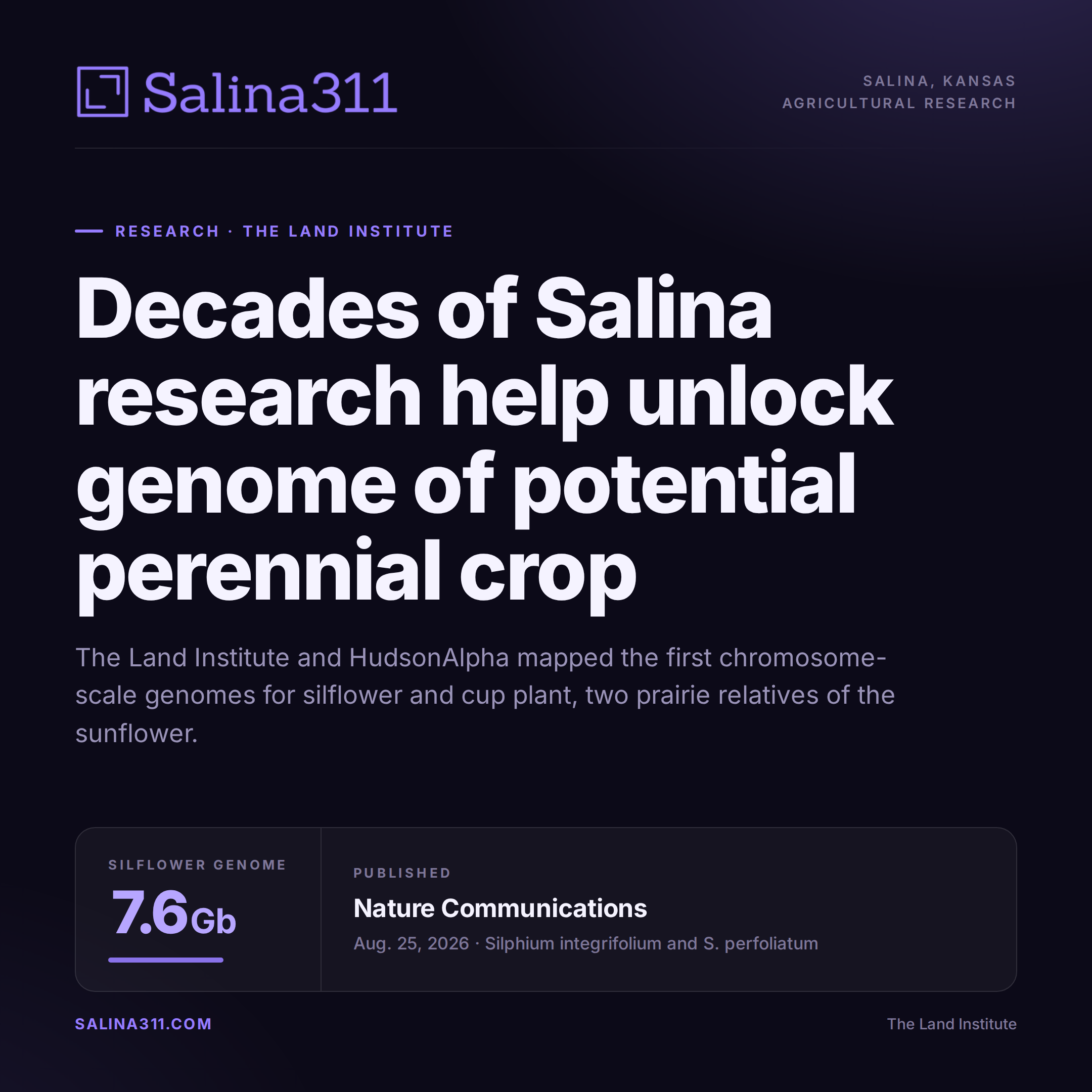
A plant-breeding effort that began in Salina roughly 25 years ago has helped produce the first chromosome-scale genomes of two North American prairie plants being studied as potential perennial crops.
The research, involving scientists at The Land Institute in Salina and collaborators around the country, was published July 9 in Nature Communications, one of the Nature portfolio's peer-reviewed scientific journals.
The study focuses on Silphium integrifolium, commonly known as silflower, and Silphium perfoliatum, commonly known as cup plant.
David Van Tassel, lead scientist for perennial oilseeds at The Land Institute, is one of the researchers behind the work and is listed as the paper's corresponding author.
For Van Tassel, the publication represents another step in work that began more than two decades ago.
Salina Research Dates to 2001
According to The Land Institute, Van Tassel began collecting wild silflower seed in 2001.
The organization formally incorporated silflower into its perennial-grain research program in 2003.
Since then, researchers have worked to domesticate the native prairie plant into a crop capable of producing useful oilseed yields while maintaining characteristics associated with perennial plants.
Unlike annual crops that must be replanted every year, perennial plants remain alive for multiple growing seasons.
Silflower develops deep roots and has demonstrated drought tolerance, while also providing habitat for pollinators and helping protect soil.
Researchers Build First Chromosome-Scale Genomes
The new study provides researchers with detailed genetic maps of silflower and cup plant.
Scientists assembled what are known as chromosome-scale, haplotype-phased genomes, allowing researchers to examine the plants' genetic structure at a level that previously was not available.
The genomes are unusually large.
According to the study, individual chromosomes can reach approximately 1.8 billion base pairs, illustrating one of the challenges scientists faced in assembling the genetic information.
The research also identified 81 genetic locations associated with environmental adaptation and domestication-related traits.
Those findings could allow plant breeders to more precisely identify characteristics such as disease resistance, adaptation to different climates and traits useful for transforming a wild plant into an agricultural crop.
Research Included Salina Field Trials
The work was not limited to laboratory sequencing.
Researchers grew replicated populations at both HudsonAlpha Institute for Biotechnology in Huntsville, Alabama, and The Land Institute's research fields in Salina.
Field measurements were collected in Kansas and Alabama during 2024 and 2025.
Van Tassel contributed plant material and interspecies hybrids used in the project and participated in field trials, plant selection and development of the research paper.
Land Institute scientists Kathryn Turner and Betsy Trana are also listed among the study's authors.
Why Researchers Are Interested in Silflower
Silflower is a member of the sunflower family native to the North American prairie.
The Land Institute has been attempting to domesticate the plant as a perennial oilseed crop that could potentially serve some of the same agricultural markets as annual crops including sunflower, canola and soybean.
Researchers say perennial crops could provide environmental advantages because their extensive root systems remain in the ground year after year.
Those roots can reduce soil disturbance, improve water access and potentially provide habitat and other ecological benefits not associated with repeatedly planting annual crops.
Silflower's roots can reach groundwater several feet below the surface, according to The Land Institute.
National Attention Arrives Weeks After Publication
Although the scientific paper was published July 9, the research received additional national attention this week after The Land Institute issued a release describing the genome work.
The Aug. 24 announcement described the research as a potential tool for accelerating the domestication of Silphium species for uses including food, fiber and forage.
The project involved researchers from The Land Institute, HudsonAlpha Institute for Biotechnology and several other universities and research organizations.
The research was funded in part by The Land Institute.
From Wild Prairie Plant to Potential Crop
The publication does not mean silflower is ready to replace existing commercial oilseed crops.
Domestication of a wild perennial plant is a long-term process involving generations of selection for yield, seed size, disease resistance, harvestability and other agricultural traits.
The significance of the new genome is that researchers now have a genetic reference that can help identify and select those traits more efficiently.
For Van Tassel and The Land Institute, that genetic tool comes approximately 25 years after the first wild silflower seeds were collected for the Salina research program.
The study, “Assembly of Silphium interspecific hybrid genomes opens the genus to phylogenomics, ecogenomics, and molecular breeding,” appears in Nature Communications, volume 17, article 8499.
Want this story in print?
We'll print this story on the cover and inside of a keepsake 4-page paper, then package it and ship it right to your door.
Sign in to save 10% — paid members save 20%.
