Salina’s Arts Strengths Highlighted at City Commission Study Session; Keen Says Workshop Was Not a Scientific Poll
Live: Keen Research Highlights Salina’s Arts Strengths; Workshop Was Not a Scientific Poll
The Salina City Commission’s study session is still underway. Salina311 will continue updating this story as the meeting progresses.
Alex Keen of Keen Independent Research told commissioners Monday that feedback from a virtual workshop helped inform a preliminary cultural plan, but the workshop was not designed as a statistically significant poll of Salina residents.
“We don’t ever say these surveys are statistically significant,” Keen said. “If you want to do that, you hire a polling company and you ask specific questions.”
The workshop drew more than 700 participants and included closed-ended and open-ended questions. The research team also conducted site visits, interviews, small-group meetings and a community meeting. Residents could submit feedback by calling a hotline or emailing the study team.
“Anybody, an arts lover or an arts detractor, could call us on the hotline or email us on the study email address and share their feedback about the future of arts and culture in Salina,” Keen said.
The workshop was voluntary, not a random sample of residents. Its results describe the views of participants, but cannot establish how Salina residents as a whole feel about arts and culture.
Workshop responses and research findings
Keen said about 60% of workshop participants were not closely affiliated with the arts sector or government. About 23% identified as hobbyist artists or creatives, and fewer than 12% identified as professional artists. He said most respondents lived in or near Salina.
Among workshop respondents, 89% agreed that arts and culture add to Salina’s appeal. Eighty-one percent agreed with supporting city funding and resources for arts and culture, while 79% said private businesses have a key role in investing in the sector. Those figures describe workshop participants, not a representative sample of the city’s population.
Heather Calvin, an associate principal with Keen Independent Research, said the team looked for themes across the workshop, interviews, site visits, meetings, market and demographic analysis, and existing data. The researchers also worked with city leaders and the Cultural Directors Roundtable.
The team identified Salina’s public art, cultural institutions and regional events as strengths. Keen said Salina’s cultural assets are “really, really special,” singling out the mural program and saying the firm was already showing it to clients elsewhere.
Calvin said the team found Salina’s arts assets and infrastructure “unexpectedly strong” for a community of its size. Using the SMU DataArts Arts Vibrancy Index, she said Salina ranked in the top 30% among Midwestern cities of all sizes, the top 20% among small U.S. cities and the top 15% among small Midwestern cities.
Report estimates $11.37 million in attendee spending
Brad Anderson, director of Salina Arts and Humanities, presented the department’s State of the Arts report. He said the report reflects the city’s annual support for the cultural sector through transient guest tax, in-kind services and other financial contributions.
“One of the things on the second-to-the-last page on the combined impact report shows that the total estimated spending by people attending cultural arts events from just these eight agencies that are represented in the report is $11,374,000,” Anderson said.
He said the estimate is in addition to ticket or admission costs and is based on an indicator from Americans for the Arts’ Arts & Economic Prosperity report, which surveyed attendees in 360 communities about their spending, length of stay, lodging, shopping and other expenses.
Anderson said the report also listed $3.8 million in additional spending by local attendees. He cited national survey results indicating that about half of respondents would seek cultural events elsewhere if they were not available in their community.
“When you come from outside of the community and come and participate in a cultural event, you’re going to spend more than the locals do, and it’s substantially more for those out-of-town visitors,” Anderson said. He said attracting visitors to cultural events can benefit the local economy.
The spending figures are estimates based on the report’s methodology, not a count of verified individual transactions.
Five proposed priorities
Keen outlined five proposed strategic priorities for the cultural plan:
- Sustain and strengthen Salina’s cultural foundation.
- Make arts and culture more accessible, visible and relevant to all of Salina.
- Make Salina a place where artists and creatives can build a life and career.
- Connect Salina’s cultural ecosystem and build shared capacity.
- Use arts and culture to strengthen Salina’s identity, downtown vitality and regional appeal.
Keen recommended assessing maintenance and capital needs for existing cultural assets before pursuing major new facilities. He also suggested identifying underused rooms, stages, studios and properties that could be made available through shared-use agreements, and considering low-cost reservations or subsidies for rehearsal, small performances and community gatherings.
Other proposals include expanding arts and cultural activities into neighborhoods, improving access for children and young adults, coordinating information about grants and artist opportunities, and strengthening the Cultural Directors Roundtable as a vehicle for joint work.
The researchers also identified gaps in affordable workspaces for artists, venues for small and midsize performances, and opportunities for teens and young adults. Calvin said participants raised concerns about finding information on local arts events and about Salina’s cultural assets being less visible to people outside the city.
The team said some local cultural organizations draw substantial audiences from outside Saline County. Based on fiscal year 2025 reports, the share of audiences from outside the county ranged from 36% for Theatre Salina to as much as 70% for another organization in the data reviewed.
Next steps
Calvin said the research team will continue developing the plan in November and review it with the Cultural Directors Roundtable. Revisions, implementation steps and performance measures are planned for December.
A public draft review is expected in early January, followed by Arts Commission review. The final plan is expected to go to the City Commission for presentation and potential adoption in late January 2027.
This story will be updated as the study session continues.
 | Salina ranks in top 15% of small Midwest cities for arts, but consultants flag gaps in venues, teen options and awarenessSalina ranks in the top 15% of small Midwest cities for arts vibrancy, but residents see gaps in mid-size performance space, offerings for teens and young adults, and ways to learn what's happening, according to an update on the city's … |
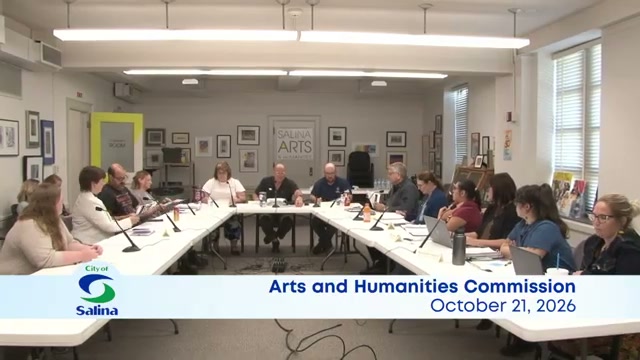 | Salina Cultural Plan Draft Outlines Five Goals Ahead of City Commission SessionThe Salina Arts and Humanities Commission reviewed a preliminary draft of the city's cultural plan during its October 21 meeting, in advance of a presentation scheduled for the Salina City Commission in a study session at 2 p.m. Monday, October … |
 | Brad Anderson to Present Salina Study on Arts Funding and Cultural Priorities Oct. 26Salina’s new cultural plan is intended to guide future decisions about arts programming, cultural services, public investment and priorities for the coming years. The plan will include recommendations and an implementation roadmap for city consideration, potentially influencing which initiatives receive … |