
City Memo Shows $8.16 Million Spent on River Renewal Project, With $9.38 Million Still Set Aside
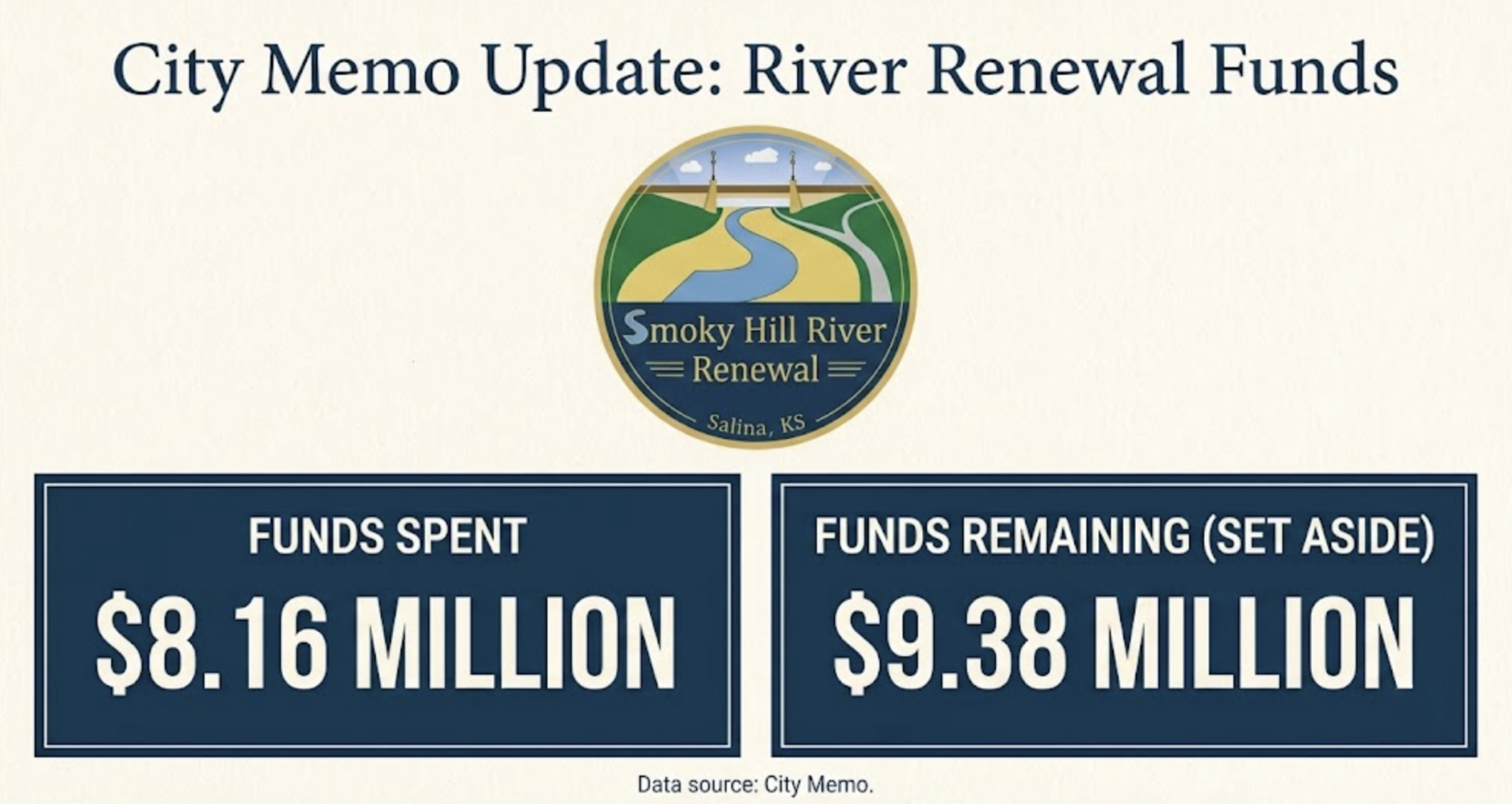
A new funding breakdown from the City of Salina shows the Smoky Hill River Renewal Project has already used $8,160,838.78, with the majority of that spending going toward design.
The figures were included in a July 6 email from City Manager Jacob Wood to the mayor and city commissioners. Wood wrote that he had been asked to provide details about River Renewal funding and that city staff had prepared a list of funding sources and spending to date.
According to the city’s breakdown, Salina has identified $17,540,929.30 for the River Renewal Project. Of that amount, $8,160,838.78 has been spent, leaving $9,380,090.52 in cash on hand.
Where the Funding Came From
The largest source of funding listed by the city is $6,065,184.96 in sales tax money directed from Kenwood Cove debt. The city also lists $5,368,647.10 in bond proceeds, $5 million transferred from the General Fund, and $1,107,097.24 in ARPA funds.
Together, those four sources make up the full $17.54 million currently identified in the city’s memo.
The breakdown shows that the project is not being funded only through grants or outside sources. Local public dollars, including sales tax revenue and a General Fund transfer, make up a significant portion of the funding identified so far. Bond proceeds are also part of the funding structure, meaning borrowed money is included in the current project financing.
| Source of Funds | Amount |
| Sales tax directed from Kenwood Cove debt | $6,065,184.96 |
| Bond proceeds | $5,368,647.10 |
| Transfer from General Fund | $5,000,000.00 |
| ARPA funds | $1,107,097.24 |
| Total | $17,540,929.30 |
Most Spending Has Gone Toward Design
The largest expense listed in the memo is design, at $7,193,029.52. That accounts for about 88% of the total money spent so far.
The city also lists $687,280.92 for feasibility studies, $109,762.10 for property acquisition, $99,272.10 for cost of issuance, $67,834.51 in debt interest, and $3,659.63 in miscellaneous expenses.
No construction expense is listed in the city’s current use-of-funds summary.
| Use of Funds | Amount |
| Design | $7,193,029.52 |
| Feasibility studies | $687,280.92 |
| Property acquisition | $109,762.10 |
| Cost of issuance | $99,272.10 |
| Debt interest | $67,834.51 |
| Miscellaneous | $3,659.63 |
| Total spent | $8,160,838.78 |
Earlier Public Number Was Not the Full Picture
The new memo gives a broader financial picture than earlier public discussions that focused on a smaller figure, previously understood to be around $1.8 million in project-related costs.
Based on the city’s latest breakdown, that smaller number did not represent the total amount spent on the River Renewal Project. Instead, it appears to have reflected only a limited portion of the project, such as property acquisition or related costs.
The July 6 memo shows that total spending is substantially higher when design, feasibility studies, bond-related costs, interest and other expenses are included.
A Larger Financial Picture
The River Renewal Project has been discussed for years through different funding sources, project phases and public agenda items. Those pieces include local sales tax money, bond proceeds, General Fund money, federal ARPA dollars and other project-related funding discussions.
The July 6 memo does not show that all project money has been spent. It does show that the city has already spent more than $8.16 million, with more than $7.19 million spent on design alone.
The memo also shows that the city still has $9.38 million in cash on hand for the project.
The latest city memo shows a project with a larger financial footprint than some earlier public discussions may have suggested. While previous references focused on a smaller portion of the project, the city’s own breakdown now shows more than $17.5 million in identified funding and more than $8.1 million already spent.
As the project continues, the new numbers raise a basic public question: whether residents have been given a clear understanding of the total cost, the funding sources and the amount already spent before construction costs appear in the city’s spending summary.