Salina’s River Renewal Funding Has Grown Beyond the $1.3 Million-a-Year Plan Presented in 2016
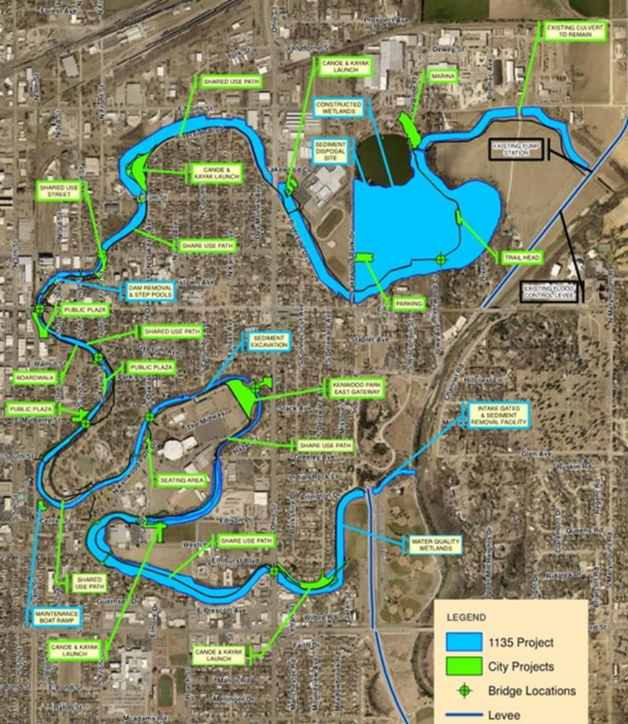
When Salina voters considered a new city sales tax in 2016, the local funding plan publicly described for the Smoky Hill River Renewal project was relatively simple.
About $1.3 million per year from the existing sales tax was being used to make debt payments on Kenwood Cove. Once that debt was retired, city officials said the same annual amount would be redirected to the river.
An April 17, 2016 Salina Journal article quoted then-City Manager Jason Gage explaining that plan. The article said the Kenwood Cove bonds were expected to be paid off in 2019 and that afterward, “the $1.3 million a year would go toward the river project.”
Gage also told the Journal that the City did not want to spend more annually than it was already spending on Kenwood Cove debt and that he did not believe it would need to.
Ten years later, that $1.3 million annual sales-tax allocation still exists.
What has changed is the size of the project and the amount of additional local funding now associated with it.
What voters actually approved in 2016
The Smoky Hill River Renewal project was not specifically named in the ballot language.
The ballot instead asked voters to replace the existing 0.40% sales tax with a 0.75% general-purpose retailers' sales tax. The listed purposes included streets and drainage, maintaining a stable property-tax rate, parks, capital improvements, equipment, bonded debt and economic-development efforts.
However, the April 2016 Journal article makes clear that before the vote, city officials publicly identified the river as one intended use of the tax.
The City's River Renewal information has continued to describe the original river funding stream as approximately $1.3 million annually for 16 years, or about $20.8 million.
That $20.8 million provides a useful benchmark for comparing the original local funding plan with what exists today.
The $1.3 million annual allocation remains
Current City documents continue to identify $1.3 million per year from sales-tax revenue as a funding source for the City's portion of River Renewal.
But the same City documents now identify additional funding sources, including a $5 million transfer from the General Fund, private funding through Friends of the River and possible downtown STAR Bond funding.
The City has also begun acquiring property needed for the project. A May 2026 City staff report estimated property-acquisition costs at approximately $1.415 million, including property and easement compensation, appraisal work, surveys, title insurance and acquisition services.
In other words, the original $1.3 million annual allocation has not been replaced. It has become one part of a larger financing structure.
Two major projects now make up much of the work
The current River Renewal effort includes two major publicly funded project packages.
The first is the City's RAISE Grant - Old Smoky Hill River Bridge Replacement Project.
The City currently estimates that project at $33,787,620.
Of that amount:
Federal RAISE grant: $22,112,620
City of Salina share: $11,675,000
The project includes seven bridge projects, multi-use trails, pedestrian improvements, lighting, a multimodal hub, a retaining wall at the water treatment plant, a river maintenance facility and boat ramps, boardwalk improvements and other infrastructure.
The second major piece is the U.S. Army Corps of Engineers aquatic ecosystem restoration project.
The City's existing webpage still shows an earlier estimate of $21.315 million, including a $7.61 million non-federal share.
However, the latest Chief of Engineers document posted by the Corps, which is labeled a “Proposed Report,” now estimates the ecosystem-restoration project at:
Total estimated cost: $54,234,000
Federal share: $35,252,100
Non-federal share: $18,981,900
The Corps says the estimate is based on October 2025 price levels.
What does the nearly $19 million Corps share mean for Salina?
The $18.982 million non-federal share should not be interpreted as a check the City must write entirely in cash.
The Corps estimate includes approximately $10.789 million in land, easements, rights-of-way, relocations and disposal areas. The City can receive credit for qualifying property-related contributions toward its share.
The Corps nevertheless identifies the City of Salina as the project's non-federal sponsor and assigns it a 35% share of the project.
That is important when comparing today's financing picture with the one presented in 2016.
How the local side compares with the original funding stream
The original sales-tax funding stream was expected to provide approximately:
$20.8 million
Today's two major project packages list:
| Project | Current listed local/non-federal share |
| RAISE/Seven Bridges | $11.675 million |
| Corps ecosystem restoration | $18.982 million |
| Combined | $30.657 million |
The combined listed local shares are approximately:
$9.86 million higher than the original $20.8 million sales-tax stream
That is about 47% more.
That comparison does not mean the City has already spent $30.657 million, nor does it mean taxpayers must provide that entire amount in new cash.
Some of the Corps contribution can be met through property and easement credits. Federal grants cover large portions of both projects, and private contributions are also helping fund elements of the broader River Renewal effort.
What the comparison does show is that the local financial responsibility now associated with the major River Renewal projects is larger than the $20.8 million sales-tax stream originally described.
Here’s the easiest way to understand the change
| 2016 public picture | 2026 documented reality |
| About $1.3M/year from Kenwood Cove debt redirected to the river | The $1.3M annual sales-tax allocation still exists |
| Gage said the City did not want or expect to spend more than the Kenwood Cove amount annually | City documents now identify additional local funding sources |
| About $20.8M expected from the 16-year river sales-tax stream | Current major-project local shares total about $30.66M, roughly $9.86M or 47% higher |
| Local funding centered on the redirected sales-tax stream | City documents now also identify a $5M General Fund transfer, private funding and possible STAR Bond funding |
| River work centered on restoring flow, removing sediment and adding trails and public spaces | Current work includes ecosystem restoration, seven bridge projects, trails, underpasses, land acquisition and additional public infrastructure |
| Federal participation was still developing | RAISE now provides $22.113M toward a $33.788M project |
| Earlier City estimate put the Corps project at $21.315M with a $7.61M local share | Latest Corps estimate is $54.234M with an $18.982M non-federal share |
| No annual maintenance figure was identified in the 2016 article | Corps now estimates $348,280 per year in additional maintenance, assigned entirely to the non-federal sponsor |
The Corps project itself has also become more expensive
The difference between the City's existing webpage and the latest Corps estimate is substantial.
The City's page lists the Corps project at $21.315 million.
The newer Corps document estimates it at $54.234 million.
That is an increase of approximately:
$32.9 million, or 154%
The non-federal share shown for Salina increased from $7.61 million under the earlier estimate to approximately $18.982 million under the latest Corps estimate.
That is an increase of approximately:
$11.37 million, or 149%
The latest number is still an estimate rather than a construction bid. The Corps says the overall recommended plan is approximately 35% designed and identifies cost and schedule risks that could push its $54.234 million estimate to approximately $62.725 million.
The two major project estimates now total about $88 million
The City's RAISE project currently has an estimated cost of approximately $33.788 million.
The latest Corps estimate is approximately $54.234 million.
Together, those two major project estimates total approximately:
$88.02 million
That should not be characterized as a final, all-in cost for every element associated with River Renewal.
However, the Corps specifically states that Salina's seven bridge modifications and one culvert modification are not included in the Corps' $54.234 million recommended plan, supporting the distinction between the Corps restoration project and the City's bridge work.
Salina will also have an ongoing maintenance obligation
Construction costs are not the only financial change.
The latest Corps report estimates an additional $348,280 per year for operation, maintenance, repair, replacement and rehabilitation of the ecosystem-restoration project.
The Corps states that the non-federal sponsor, the City of Salina, would be responsible for 100% of those costs.
That represents an ongoing expense after construction is completed.
What has changed since 2016?
The simplest answer is that the original funding source remains, but the project around it has grown.
In 2016, residents were told that approximately $1.3 million per year previously used for Kenwood Cove debt would eventually be redirected to the river. Gage said the City did not want to spend more annually than it was already spending on that debt.
That $1.3 million allocation continues today.
But current City and federal records now show a substantially larger financing structure that includes the continuing sales-tax allocation, a $5 million General Fund transfer, federal RAISE funding, a federal-local Corps partnership, private contributions, property acquisition and other potential funding sources.
The comparison does not establish that the City violated a legal spending cap because no $1.3 million annual cap was written into the 2016 ballot.
It does establish that the local financial commitment associated with today's River Renewal projects has grown beyond the $20.8 million sales-tax stream that formed the core of the funding plan publicly described in 2016.
Want this story in print?
We'll print this story on the cover and inside of a keepsake 4-page paper, then package it and ship it right to your door.
Sign in to save 10% — paid members save 20%.
